Thursday, March 8, 2012

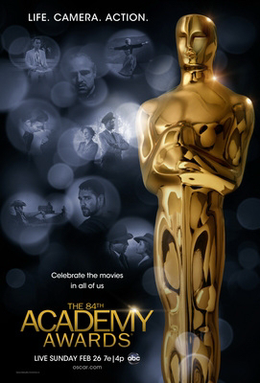
Why the Oscars stunk in 15 contentions

1. The Descenwhats?
I was (once again) expected to root for a cacophony of dull, pretentious “made-for-Oscar” movies which neither I nor anyone else besides critics actually saw.  At least they gave us Inception last year (albeit while ignoring Christopher Nolan).

2. Pervasive anti-Republican and anti-capitalism sentiment from the host and presenters
We’ll be examining this negative impact through several sub-points.
A ) Let’s look first at Billy Crystal’s opening statement: “What better way to take our minds off the poor economy than to watch millionaires accept golden statues on a stage?”  While a seemingly innocent observation, this quote actually had anti-bourgeois connotations.  Crystal was implying, “Life is already fortunate enough to the wealthy.  They have the exclusive privilege of being able to receive a shiny statue in front of millions of struggling Americans (who can also afford monthly bills on their TV).  The 1% ought to give half or more of their money back to the government.”
B ) In his presentation, Chris Rock explained the simplicity of his job as a voice actor in plain terms: “I go in a sound booth, say some lines, and they hand me a MILLION DOLLARS!”  While it is true that voice actors earn an absurd paycheck for their work, Mr. Marty the Zebra was implying that movie stars don’t have a right to their money and that the government should take more out of their salaries than they do currently.
C ) About halfway through the show, Billy Crystal questioned the income tax rate paid by the Harry Potter special effects team.  He openly wondered how a giant movie series could gross $7.7B but the computer guy responsible for the series’ magic could pay just 14% in income taxes.  I inquire, what’s his bright line?  No definition of FAIR SHARE, judge.
D )  The previous 3 sub-points are eclipsed by this final one, for Crystal crossed the line when he unreservedly mocked the Republican presidential candidates.  “A dark knight, an American psycho, and a charismatic crack addict.  You’ll choose one on Super Tuesday.”  Ha ha.  You just slammed the entire conservative population on a national television awards program which is supposed to be about movies.  Nice one, Billy.  You sure had Clooney laughing, along with 99% of those other actors.  Out of curiosity, whom were you dubbing a drug addict?

Edit: Chris Rock is not just a liberal moron who calls the Tea Party movement "racist"; he's also a liberal jerk who breaks an author's camera when questioned about that insulting claim.  I'm boycotting his films.

3. Racial humor
What can you expect from the liberal entertainment industry?  They’ve got to make race an issue in everything.

4. The cameraman’s obsession with Hollywood’s liberal elite
I watch the Oscars for the movies, not for endless headshots of Clooney and Pitt.

5. Strapless dresses
I’m a guy, so I don’t really care about fashion, but still I inquire, “Why?”

6. Duo interpretations – I mean presentations
These were all beyond awkward, because none of these “actors” knew how to recite their parts in a way that didn’t sound scripted.  And they were totally scripted.

7. The Descendants stealing best screenplay
I’m supposed to believe that Alexander Payne, who co-wrote Jurassic Park 3, is a better screenwriter than Steven Kloves, who adapted the final Harry Potter movie?  Hugo, no.

8. Hugo stealing Rango’s awards
Of all the movies I’ve ever seen, Rango had some of the most dramatic camera work.  And the character design of Rattlesnake Jake has to count towards the art awards, right?

9. Hugo stealing Transformer’s awards
In what world do Hugo’s special effects hold a candle to the jaw-dropping explosions and robot carnage of Transformers 3?  Sure it was mostly CGI, but T3 boasted probably the most detailed and complex animated shots in movie history, and its sound effects were incredible.  What the Hugo happened?

10. Mission Impossible getting overlooked
The Burj Khalifa scene alone merits a nod to this movie’s cinematography.

11. Jonah Hill and Melissa McCarthy
“You have to get back ON MY SEAT… Get it?”  Kind of vulgar and R-rated, but I get it.  What I don’t get it how you were nominated.  Jonah Hill lost his chance to be taken seriously when he signed up for so many moronic guy comedies.  “I see, lady, the gentleman is not in your books.”  “No, an he were, I would burn my study.”

12. The Girl with too many Oscar nominations
Whatever angle you look at it from, The Girl with the Dragon Tattoo is a disgusting and immoral pile of dung.  So why even consider it for an award?

13. Andy Serkis losing to a silent film actor
The Frenchman from The Artist can dance, smile, and silently scream at the camera;  that’d be an impressive performance – in kindergarten.  Serkis, on the other hand, created an ape that was believable within the boundaries of the movie and that could capture the sympathy of the film’s audience even while he rebelled against his oppressors and led an uprising against Earth’s dominant species.  In my mind, there’s no question as to who is the better actor.

14. Christopher Plummer stealing Alan Rickman’s award
Let me tell you the two reasons why Plummer won and Rickman was snubbed.  #1.  Beginners is a movie about “diversity” and “acceptance”,  if you know what I mean.  Surprisingly, Plummer didn’t play the tolerance card at all in his acceptance speech.  His age has brought him more wisdom than Sean Penn’s… #2.  Alan Rickman is automatically disqualified for the supporting actor recognition because he plays Severus Snape, a character from the fantasy movie Harry Potter and the Deathly Hallows Part 2.  The Academy has repeatedly shunned films of the fantasy or sci-fi genre, locking them out of any categories besides those for visual and sound effects.  Every now and then we see an exception, such as Return of the King in 2003, District 9 in 2009, or Avatar (which honestly only made it through because it was liberal propaganda), but the vast majority of deserving “popular” movies (The Matrix, Revenge of the Sith, Batman Begins, King Kong, The Dark Knight, Star Trek, Thor, and Harry Potter 7.65 to name a few) are ignored for the top prizes.

15. The Artist taking best picture over Rango
Rango is a thought-provoking, dramatic Western about one man/chameleon having to determine his identity after “being propelled into conflict”.  It has witty humor, subtle metaphors, and beautiful animation on top of its story.  The Artist is simple; one can describe it as a silent film about silent film actors living in the era of silent films.  Primitive.

Wednesday, March 7, 2012

Overpopulation – A Bird's Eye View

Warning: Disturbing images of pollution, environmental degradation, umm, dead animals which had NO natural habitat left, and, err, disgusting humans.

Poor Bambi has NOWHERE to roam any longer.

The Chinese have it right... humanity is a VIRUS.  Pregnancy should be CONTROLLED, lest we OVERRUN the planet.


To quote a Rush Limbaugh parody, "WE are the problem!"


... I love to break it to you guys, but for every square mile of land occupied by homo sapiens, there are another 9 miles which aren't.  Sorry, James Cameron.

Monday, February 20, 2012

Times are CHANGING, Mr. Rango...

The Author's Files is undergoing renovation.  If anything on your screen looks disproportoniate, misplaced, or awkward in general... you now know why.

I'm hoping to create a new background and edit the colors while I'm at it.  Do not panic; all will be well again soon.  These changes are not meant to remake The Author's Files, but to reform it.  The "change" I describe is progress, not regress.

Sunday, February 19, 2012

Fate and Free Will in Hellboy and Shrek – classical movie review

Once again, this paper was originally written according to Classical Writing outlines and essay structures. Mrs. Weitz kind of let us loose for the last week and allowed us to write about anybody or anything we wanted, movie characters included. : ) To be honest, I was a little liberal with the comparison essay structure. The "deeds" paragraphs don't really describe the achievements of the characters so much as my speculations on the character progression and development. Still, this is probably one of the most insightful and reflective movie reviews you'll ever read, in my humble opinion.

Without further ado, my classical review of two of history's best movies ever.


The most intriguing heroes to our society are not the ones with flawless physical attributes, nor are they the ones who must overcome no barriers to achieving their greatness.  Rather, we are fascinated by those who exceed our expectations, surpass their ancestors, and succeed in spite of their natural limitations.  Humans are drawn to those who, like them, must grapple with their own weaknesses and fallen nature. Hellboy and Shrek are two fictional figures who embody the concept of the physically flawed and emotionally tormented hero, who throws off the shackles of Fate to create his own destiny and truly become a man.

At their fundamental level, both characters are monsters. Hellboy is a living demon, who escaped from the Inferno after a failed Nazi operation in 1944.  Adopted by a professor of the paranormal, he is raised as a regular human and confined to the headquarters for the United States Bureau of Paranormal Research and Defense.  Hellboy’s knowledge of paranormal creatures enables him to fight and subdue them, and despite his heritage he becomes a resourceful ally for the human world.  Shrek, a green ogre who presides over a swamp, has a more ambiguous background, although the reputation of other ogres clearly led human beings to fear and disdain him, treating him as little more than a bloodthirsty animal.

The most obvious line one can draw connecting Shrek and HB is their outer appearance and ugliness.  Both resemble what the eyes perceive and label a monster; Shrek’s massive size and menacing teeth create a frightening figure, and try as Hellboy might to fit in by filing his horns, his stature will always appear demonic to spectators.

In both instances, people react the same way to these characters: with hate and apprehension.  In a humorous scene from the movie, Hellboy tries to board an underground subway after a violent hellhound rampages through from one end to the other.  Reaching his arms over the ledge, he tries to appease the conductor, saying, “I’m on your side.”  The man greets him with a heavy object to the skull.  While the scene has no long-term significance, it establishes that the story’s protagonist is not treated warmly by the world, no matter his heroic deeds.  A more somber scene later on illuminates the very predicament of Hellboy’s existence; in a heated argument, the director of the FBI exclaims the apparent truth: “This whole thing is a farce, because in the end, after you’ve killed and captured every freak out there, there’s still one left: you.”  This causes Hellboy to grapple with his own emotions and question who he really is.   Shrek is received in much the same way by the world outside his swamp.  The film opens with an expedition by several townsfolk to go and “slay the beast” with their torches and pitchforks.  Anti-ogre sentiment is displayed throughout the movie, and Shrek is frequently judged only by his outer appearance.  Hellboy and Shrek are both unfairly stereotyped by the peoples of their fantasy universes, but their characters differ significantly in that Shrek is more critical of himself, believing for a while the horror stories spread about him.  He accepts the position that society has assigned him, and resigns himself to be forever a monster and never a hero.  This is due largely to his voluntary life of isolation and exile; until Donkey comes along, Shrek has no close friends and no one who recognizes his good qualities. Hellboy grew up in a family, and as a result has a higher esteem for himself.  On the other hand, when HB hears deceptions from other demons, he struggles with his own identity and transforms somewhat into the role Shrek occupied formerly, a depressed creature who doubts his own capacity for goodness.  At the climax of the first movie and throughout the second, Hellboy ponders just how different he is from the monstrosities which he fights, and wonders whether his origins prevent him from truly having a choice in what life he leads.  The difference in the two heroes can be summed up this way: Shrek initially doubts himself, but realizes after an adventure that his own virtues, not society’s opinion of him, define who he is.  Hellboy, confident to begin, takes many of his choices for granted, but comes to wrestle with his own nature after maturity.  Being confronted by visions of himself as a servant of Chaos, he wonders if he can really choose his own fate in light of his lineage.

The themes of both characters’ stories are ones of free will and opportunity, even for the most ill-fated of God’s creations.  For a long time, Shrek hopelessly permits humans to decide his defining image, even though he has a heroic heart.  That changes when Lord Farquaad inadvertently sets him and his “noble steed” on a quest to rescue a princess.  Over the course of this journey, Shrek determines that his character is not ultimately dictated by other people, and that he is in charge of his own destiny.  He need not be a stupid, ugly ogre if he does not want to bear that name.  Hellboy’s enemies often attempt to bring him back to the dark side of the heavenly war, by calling out his detachment from the human world.  In the first film, they almost succeed in making him literally unleash Hell upon Earth, but HB remembers the Catholic sign of the cross around his neck, and in that moment he grasps that he has a choice in what life he leads, no matter the evil of his ancestors.

In conclusion, Hellboy and Shrek are both profound symbols of any man’s power to decide his own destiny.  If Fate ever designated anyone to be a villain, Hellboy and Shrek would have been doomed to evil paths, but through Free Will they established their own identities as heroes, not as monsters, but as men.

Saturday, January 7, 2012

The Fed: A Lego builder's perspective

2009 (Year 1 of Obama's office) -
LEGO Star Wars Clone Walker Battle Pack (#8014) – $10.99
2012 (Year 4 of Obama's office)
LEGO Star Wars Elite Clone Troopers and Commando Droid Battle Pack (mouthful) – $12.99

Ah, come on.  Obama, Bernanke, and their cronies only devalued the dollar by 20% in his first term.  That's a pretty small percentage considering the economy he inherited from a Republican president – the economy, I should add, wherein you could purchase Lego Star Wars sets for $10.  And some people think printing money can solve every problem...