Thursday, May 17, 2012

The worst TP arguments – 2012 edition

Here are the top 20 arguments you don’t want to make at NITOC 2012, in somewhat random order from generic to specific.  I'm not asserting that these arguments don't win rounds; I’m just saying they’re really bad and lack logical foundations.  You can call most of them subjective, but I don’t believe in subjective reality.


1. Policy vs. policies
The latter interpretation would grant the affirmative team access to approximately 0 cases.  Enough said.
2. “1-step” topicality
I don’t know where this originated, but I’ve seen at least two teams from different clubs try to sell it.  It doesn’t make any sense.  The resolution doesn’t say you have to reform “in 1 step”.  I don’t even know what “in 1 step” means.  With one mandate?  With one immediate timeline?  The vast majority of judges are going to have no clue what “in 1 step” signifies and you’ll only waste your time trying to explain it.
3. Topicality on tax credits, deductions, “loopholes”
Tax breaks aren’t revenue generation policies because they reduce generated revenue?  Time suck.  Here’s how you take it out in cross-ex: “Are tax breaks related to taxes?”… “Are taxes revenue generation policies?”… “Therefore, by eliminating/installing tax breaks, you simultaneously reform federal revenue generation policies.  Next question.”  Case closed.
4. Only taxes are revenue
“My standard is limits, because we should limit the resolution as much as we possibly can…” 
5. Significance without a brightline
How can I ever be significant if the negative team hasn’t even said what is significant?
6. Future inherency
You can either pass the plan now, killing the death tax once and for all, or wait and *see if* Mitt Romney wins the election.  If he does, then you’ll get to wait and *see if* he doesn’t change his position again.
7. Inherency on a real-world plan
“Judge, this plan has already been introduced and the affirmative team hasn’t given you evidence from this morning that the bill has not been passed."
8. “State taxes” solvency
This is an especially annoying argument.  It’s like saying that the affirmative plan to save lives is insolvent because all humans die.  Likewise, the affirmative plan to kill one tax is insolvent because there are always more taxes, usually collected by the states, which are off-limits.  Stupid, I tell you.
9. Irrelevant Kritiks – e.g. prostitution
Only I and one other person will understand that header.  Anyway, here are some more examples of pathetic kritiks with no link to revenue: racism, sexism, general bigotry, name-dropping, and Skype misconduct.
10. Non-unique
This is probably the worst argument of the lot.  “We agree that the death tax is a second tax on the same man, and we agree that it denies your right to property, but there’s plenty of double taxation besides the death tax, so it’s really not a problem.”  That’s like saying sin isn’t evil because everybody is guilty of it.
11. 2 affirmative teams
“You now have two teams confirming the resolution, and you can only vote for the affirmative.”  “But WHICH AFFIRMATIVE?”  You say that 2 teams are affirming the resolution.  We say that you can only vote for one.  Also, any team which advances a counter-plan, non-topical ones included, is technically “affirming” that a change from the status quo is necessary.  There’s so not a double-standard here.
12. Biased source
So what if my writer for the Cato Institute has a libertarian bias?  That doesn’t mean he’s incorrect or a liar.  Thomas Jefferson had a bias for liberty.  I guess we should disregard his wisdom too.
13. No quantification on things not meant to be quantified
My case has advantages of fairness and the free market.  Too many times have I heard: “How much fairness do you create? How much free market are we getting?”
14. Redefining “income inequality”
I think you mean outcome inequality.  And no, it isn’t unfair.
15. X country isn’t America - without analysis
This is a popular negative response to the affirmative’s plan solvency.  It most often uses circular reasoning like this: “X country in Asia cannot be compared to the United States because it’s not like the United States.”  WHY is it unlike the United States?!
16. Lower taxes alone make jobs
Businesses don’t hire just because they have more money to spare.  Businesses will only expand their labor pool if there’s increased demand for their services.  If Apple can outsell every other competitor in America with its current employment numbers, a lower corporate tax won’t inspire the corporation to create new jobs.
17. CAF counter-plans
Civil asset forfeiture has enough weaknesses as a case that it doesn’t need a counter-plan.  When you admit that equitable sharing should be removed, you are conceding that all this exaggerated poppycock about “policing for profit” is true and that just makes the judge more attracted to the affirmative team’s plan.  It’s also dumb to believe that CAF will immediately cease if equitable sharing alone is removed.  The police will still have a motive to forfeit money: their jobs.
18. Aristocracy
This is nothing more than a really bad joke delivered in an opinion article published on a conspiracy theory website by a paranoid BYU professor who specializes in “Canadian studies”.  His message: without a death tax, the rich will rule the galaxy.
19. $1.3 trillion lost
It takes a real fool to buy that abolishing a tax which collects under $20 billion annually will cost $1.3 trillion over a decade.  The Center for Budget Policy and Priorities (*gasp**heave**water*) should go back to third grade.
20. Legalizing marijuana would be costly
Legalizing marijuana would save the government tens of billions of dollars annually.  The team which legalizes the drug claims the extra benefit of ending further spending to catch and punish its consumers, making them the only side to take an economical stance.

Monday, May 14, 2012

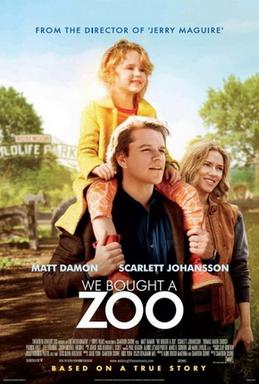
We Bought a Zoo


You know something’s wrong with Hollywood awards ceremonies when movies like We Bought a Zoo go unnoticed: movies about fractured families recovering from tragedy, movies about celebrating the present without forgetting the past, movies about taking big risks in pursuit of a better life.  We Bought a Zoo is truly the best family-centered drama to come along in quite some time.

Benjamin Mee (whose memoir is the inspiration for the movie) is the recently widowed father of two children: a 7-year old girl and 14-year old boy.  The passing of Benjamin’s wife has stricken the family with grief, but the teen, Dylan, is perhaps the most affected, as his dark and gory artwork demonstrates.  In a later dialogue, he bluntly expresses his newfound cynicism for life: “There is no sun at the end of the road that I’m aware of.”  This is, of course, a typical young man’s disposition, but the loss of his mother only amplifies Dylan’s agony.  Benjamin, also struggling with his wife’s death, aspires to start life anew and find a new home.  Eventually, he buys a private zoo.  This only adds financial troubles to his already heavy bag of burdens, which includes restoring the relationship he once had with his son and adjusting to a future without his sorely beloved wife.  Fortunately, his new neighbors - especially the hard-working zookeeper - are more than willing to assist his family through their emotional and physical hardships… 

The rest of this review will be fairly short, as I really can’t get a handle on any negative reactions I had to this movie.  We Bought a Zoo presents believable characters who act realistically given their circumstances.  Although they all are imperfect and often stumble, we still sympathize with them.  The animals may be cute, but the zoo’s higher inhabitants ultimately endear us the most, which corresponds with the movie’s message that great, human friendships are the best gift one can receive (or reject, as Ben’s son learns later).  The movie is exceptionally well acted by its stars (Matt Damon, Scarlett Johansson, Thomas Haden Church, and the three kids), and the screenwriter deserves credit for writing a moving and meaningful story. 

With that said, the movie does have a few small flaws.  Firstly, the coarse language in the movie is excessive and unnecessary for what was marketed as a family film.  This movie has mediocre reviews on Amazon precisely because a bunch of mommies took their kiddies to this expecting a clean, family-friendly, animal-indulgent happy-go-lucky romp.*  We Bought a Zoo is not that kind of movie, due to its PG-13 (albeit relatively infrequent) language and its subject matter, which won’t likely appeal much to anybody younger than 12.  I wasn’t bothered by the swearing until the end, when the little girl, Rosie, repeats a word she should not have heard.  No matter the rating of the movie, it was an inappropriate line for such a young actress to recite.  There is also a romantic subplot involving the son and a girl who lives by the zoo.  It goes a little too far to be plausible… then again, I can’t speak as my 14-year-old experience is hardly representative of everybody’s else’s, especially since I never lost my mother or moved away from urban un-civilization at that age.  Additionally, the movie commonly uses music to manipulate the viewer’s emotions in pivotal scenes, although the same could be said for most other family dramas.  Besides, the soundtrack isn’t bad. 

We Bought a Zoo is a fine movie that's best viewed with the company of a tissue box, as it will probably make you cry.  I did not, but then I haven’t cried at a movie since… 

Grade: A-


* It’s unfortunate how indicative these reactions are of our society’s stupidity.  Parents nowadays are so dumb that they’ll take their children to just whatever animated movie is released, even if it’s New Age and/or socialist dogma like Happy Feet, Astro Boy, Wall-e, Cars 2, and recently The Lorax.  Heck, the picture doesn’t even need to be animated; so long as the studio markets it to families, naïve adults will drag their even more morally ignorant children into the theater.  Parents will do so because they’re either too lazy or too foolish to do their own research and find what the movie contains.  This alone would be bad enough if such individuals did not seek to play the blame game.  Totally shirking personal responsibility, they take to the internet to mope and whine about how they were tricked into showing their children a movie improper for their eyes and ears.  What happened to being accountable for your own errors?  Karl Marx happened.  Parents were also outraged after taking their kids to Rango, which was a superb but rather mature animated movie.  If they had only looked at the content rating for Rango (and possibly Johnny Depp’s filmography), they could have deduced that the western was not suitable for their younglings.  But they did not, and someone else has to be labeled guilty for their poor thinking.  They usually target the "1%" who made the movie.

Tuesday, May 8, 2012

The Andromeda Strain


The Andromeda Strain by Michael Crichton is a chilling novel which arrests the mind from the first chapter and holds it until the very end, somehow maintaining its grip on the reader even while flooding him in a torrent of medical terminology.  While the story is not as superb or as profound as Crichton’s later work, viz. Jurassic Park, Andromeda Strain is indeed a page-turner and well worth the short time required to read it.

Crichton presents the novel as a documentation of horrific, inexplicable events which happened over the course of five days.  The story begins in the fictional town of Piedmont, Arizona, where a small satellite named Scoop 7 has crashed.  As we learn later, the intent of the Scoop program was to collect living organisms from outside Earth’s atmosphere; the seventh attempt proves successful.  However, the organism brought back by the capsule, referred to as the Andromeda Strain, has deadly effects on humans: within seconds, almost the entire populace of Piedmont is lying dead in the street.  Any “survivors” are stricken with madness and commit suicide shortly after the first wave of victims.  The capsule and the virus are swiftly transported to a secret, sterilized laboratory far beneath the Earth’s surface, where a team of 4 scientists is tasked with finding how Andromeda kills, how she reproduces, and how she can be controlled.  The laboratory, though, might not be as secure as it seems…

The Andromeda Strain is one of those really intense thrillers which are best experienced in the dark, when your mind is more prone to fear and anxiety.  Crichton weaves a vivid and truly compelling story about an unseen killer whose attack can be neither anticipated nor averted.  Here are some of the more thrilling passages in the book:

The morning sun was still low in the sky; it was cold and cheerless, casting long shadows over the thinly snow-crusted ground.  From where they stood, they could look up and down the street at the gray, weathered wooden buildings; but what they noticed first was the silence.  Except for a gentle wind that whined softly through the empty houses, it was deathly silent.  Bodies lay everywhere, heaped and flung across the ground in attitudes of frozen surprise.
But there was no sound – no reassuring rumble of an automobile engine, no barking dog, no shouting children.
Silence.

The wreckage of the Phantom was scattered over two square miles of desert.  Standing next to the charred remnants of the left wing, he could barely see the others, on the horizon, near the right wing.  Everywhere he looked, there were bits of twisted metal, blackened, paint peeling.
It was impossible to make anything of the remnants.  The fuselage, the cockpit, the canopy were all shattered into a million fragments, and the fires had disfigured everything.
As the sun faded, he found himself standing near the remains of the tail section, where the metal still radiated heat from the smoldering fire.  Half-buried in the sand he saw a bit of bone; he picked it up and realized with horror that it was human.  Long, and broken, and charred at one end, it had obviously come from an arm or a leg.  But it was oddly clean – there was no flesh remaining, only smooth bone.


I wish I could say that all of Andromeda Strain carried the intensity of these sections, but for some reason Crichton determines to kill the suspense of his own novel with lines like this:
 The team had a blind spot, which Stone later explained this way: “We were problem-oriented.  Everything we did and thought was directed toward finding a solution, a cure to Andromeda.”

Perhaps I should have written SPOILER before that, as it implies that the bacteriologist Jeremy Stone survives to relate his team’s errors.  Still, that measure would have accomplished little, because the author does a fantastic job spoiling the story himself.  Unfortunately, these revealing sentences are scattered throughout the book, alleviating much of the tension readers could have felt in the characters’ peril.  Due to these built-in spoilers, it’s difficult for us to share the fear most of the heroes experience, because we know that they’ll all turn out just fine.  I don’t recall Crichton using this narrative technique at all in Jurassic Park, which is all the more frightening because we’re unsure who will escape and who will become a meal.

As opposed to the works of Orson Scott Card, Ray Bradbury, C.S. Lewis, or even George Lucas, Crichton’s science-fiction usually places just as much emphasis on the scientific elements as on the fictional ones.  While I commend Crichton for his efforts to explain these complex subjects to the common man, the descriptions in Andromeda Strain tend to go a little overboard.  Crichton even seems to acknowledge this in the book’s introduction: “This is a rather technical narrative, centering on complex issues of science… I have avoided the temptation to simplify both the issues and the answers, and if the reader must occasionally struggle through an arid passage of technical detail, I apologize.”  These technical moments are, indeed, rather frequent, but they’re nothing which a little liberal skimming cannot overcome.

In addition to these flaws, I was also left hanging with several unanswered questions by the end of the novel.  Unresolved is the reason why one of those ill-fated bus drivers lurches forward and splits his face when Andromeda seizes him.  Unclear is the reason why a clean, polished human bone is found in the wreckage of the Phantom, although Crichton drops an ambiguous hint at its cause.  Such questions nagged me when I had finished the book.  Also disappointing is the way that Crichton promises one ending early on but delivers another, less satisfying conclusion in the final pages.  A significant detail in this story is the Odd Man Hypothesis, which states that single men are far more likely than married men to make correct decisions.  It is because of this hypothesis that a relatively inexperienced surgeon named Mark Hall is present on the Wildfire team; although he lacks the vast knowledge of the other scientists, his single status makes him a desirable asset.  In the event that the laboratory becomes contaminated, an atomic self-destruct device is primed and set to activate in three minutes.  Mark Hall, the Odd Man, is entrusted with the only key to stop this process, since it’s believed that he would make a better choice than one of his married associates.  The reader presumes initially that Hall will at some point be confronted with this potentially disastrous decision and have to choose the laboratory’s fate on his own.  Without revealing too much, I can say that no such thing happens, and the whole Odd Man subplot just feels like a tangent once you’ve finished the novel.  In fact, everything about Crichton’s conclusion disappointed me; the book has excellent buildup, but little dramatic payoff once the action reaches a climax.

Despite all these shortcomings, I still recommend Andromeda Strain.  Reading it most likely will not consume much of your time, as it’s a highly engrossing story, and the book is definitely worth a look for those who have read Crichton’s later stories and want to take a trip down history lane.  While it is not Crichton’s most superb technothriller, Andromeda Strain practically spawned a whole new genre of writing, and it merits attention for that reason.

Friday, May 4, 2012

May the Fourth be with you – Star Wars Miniland

May the force be with you, and happy Star Wars day!  To celebrate the greatest science-fiction series of all time, I want to share with you the wonders of Star Wars Miniland, to take you to a galaxy far, far away... no Legoland ticket required.

Episode 1 - The Phantom Menace


Listen closely and you can hear the Naboo starfighter blasting the droidekas the phone camera doesn't illuminate.  Please ignore shaky camera.

"There's always a bigger fish."

"Jar Jar, use a booma!"  "Mesa no have a booma!"

Trivia: the MTT extends and withdraws the droid rack.
Again, forgive my shaky camera.

And... there are no podracers.  Poodoo!

Episode 2 - Attack of the Clones

Here we have the battle of Geonosis, the only scene worth watching in the movie (and it lasts about two minutes).

I estimate they only have a few thousand more pieces than the sets Lego actually sells.


Hey, it's John Carter!!

The Clone Wars

This is the part where Snips gets some "experience".  I shudder at the memory of this movie.  Ziro, sadly, is nowhere to be seen.  "I just LOVE that little huttlet!"

Episode 3 - Revenge of the Sith

Possibly my favorite exhibit of the bunch... you can't see him in this photo, but Yoda's watching from that tower.


The turbo tank turret spins and fires, although the video doesn't show it.

"You're breaking my heart!"

The epic, animatronic duel.

Episode 4 - A New Hope (or just Star Wars, if you grew up in the 80s)


"You will never find a more wretched hive of scum and villainy."

Giants tower over the Millenium Falcon.  That's not from the movie.

Episode 5 - The Empire Strikes Back

Classic.

Episode 6 - Return of the Jedi


Han and Leia are getting comfortable in the bunker entrance.


There is, of course, more to see: the ewok village in the trees, the wampa cave, and the pivotal duel with Darth Maul, along with several other details.  Unfortunately, to see the rest you'll have to buy a $72 ticket, which I do not recommend unless you are younger than the age of 13.  Legoland has two good rides, bad animatronics, expensive food, and no real discount on the sets to compensate for your ticket price.  Oh, and most people who visit Legoland are really bad at walking, so traversing the park is a rather slow process.  This is not the theme park you're looking for.

May the Fourth be with you – Begun The Clone War Has


Most fans of Star Wars abhor the words “Clone Wars” with a passion, picturing in their minds that horror of a CGI show that currently airs every week.  Although we all recognize that the latest representation of the wars is an inept, juvenile, and utterly lackluster catastrophe, few are aware that it was preceded by two other animated movies which were truly faithful to the spirit of George Lucas’ saga.  These films were made the old-fashioned way, by artists wielding pen and paper, with little computer assistance to guide the process.  These films offered character development and gripping storytelling in addition to exhilarating action sequences.  These films captured the appeal of their live-action relatives and delivered excellent animated entertainment which was helped, not hindered, by their different presentation.  If you enjoy Star Wars, you must consider these short movies necessary viewing. 

Star Wars: Clone Wars was released on Cartoon Network between 2003 and 2005.  The series is meant to serve as a bridge between the events of Episode 2 and Episode 3 by explaining the events that led to the opening of Revenge of the Sith: how Anakin advanced to Jedi knighthood, how General Grievous obatined his famous cough, and how Chancellor Palpatine is abducted by Separatist forces.  The first volume of Clone Wars compiles an almost ceaseless series of battles in which heroic Jedi and their fearless clone allies resist the combined power of Sith warriors, battle droids, and other adversaries.  This installment is without doubt lighter on story than the other, but the fight scenes are still fantastic.  The second volume continues right from the cliffhanger not-ending of the first; it further expounds the characters of Anakin and Palpatine while introducing us to one of Star Wars’ most intimidating villains: General Grievous.

The first volume pales in comparison to the second, mostly due to the format of its televised publication.  Neither of these 1-hour movies was shown all at once initially: rather, they were originally released in short episodes which, for the first and second seasons, clocked in at about 3-5 minutes each.  There was a perceived requirement that violence or other mayhem be inserted into every one of these episodes, so the action on the first DVD (which merely strings together all the episodes chronologically) is almost nonstop.  This hurts the narrative pace of the film, because every good story needs dialogue or at least breaks in the action to progress.  The incessant nature of the fighting also mitigates the impact it has on the viewers’ senses, which is a shame as the storyboarding and choreography of the battles is excellent.  If you examine any of the great, action-filled movies, such as The Dark Knight, Inception, Lord of the Rings, Sergio Leone’s classic westerns, The Matrix, or any of the Star Wars films, you will find that the directors of these works amplify the significance of the action exactly by lowering its frequency through breaks or pauses to advance the plot. In general, the fewer special effects, galactic duels, and gravity-defying hallway stunts we see, the more effective become those we do witness.  Clone Wars: Volume 1 is handicapped by the way it was produced and aired, for it lacks any significant gap between its periods of blaster battles, lightsaber duels, and starfighter chases.  Thus, frantic action sequences and massive battles which would normally be stunning are rendered repetitive and slightly dull.

This is not to insinuate that Clone Wars finds no time for story progression whatsoever.  These two hour-long installments arguably probe deeper into the motives and desires of their characters than the new TV series has done in 3 years, and they do so even in spite of their sparse dialogue.  The series as a whole places a special focus on Anakin Skywalker and his descent into the dark side.  We see the escalating tension between him and his master, Obi-wan, which manifests his rebellious craving to be liberated from all his superiors.  We also observe how Anakin frequently resorts to that all-corrupting passion of anger to dispatch his foes.  The narrative structure, character development, and overall storytelling are undeniably better in the second volume, however.  The final episodes were released in segments of 12 minutes each, which allowed plenty of time for action and plot progression.  The latter film is also the most relevant to the rest of the saga, for it excellently depicts the events that lead up to Episode 3, concluding nicely with Anakin and Obi-Wan flying in to rescue the devious Chancellor.

Depending on your taste, you will either consider the artwork to be childish or stylish.  For me, the quality of the art varies.  Some characters, including the clones, battle droids, and Jedi, have fantastic designs, but others, such as Padme, Shaak Ti, and that little would-be-Windu farm boy, are just too cute in appearance when juxtaposed with the rest of the galactic cast.  Whatever the case, they’re all far more appealing to the eyes than those ugly, CG wooden puppets from the new series, and the animation is better as well.  The clash of the lightsabers, the droid carnage, the massive space battles, and the billowing red smoke clouds from heavy weapon collisions are all exceptionally well drawn by the animators, who clearly know their craft.

The action, while excessive, is highly entertaining and even manages to surpass some of the movies’ sequences.  The extended attack on Coruscant which results in Palpatine’s capture is especially noteworthy.  The intensity of the scenes where the Jedi flee through the city from Grievous cannot be understated, because you are fully aware they’re being hunted and their efforts to evade the droid general  only “prolong the inevitable”.  Grievous is actually fairly frightening throughout the series, more so than he is in Revenge of the Sith; there are several “jump moments” centered around his unexpected appearance and annihilation of various unlucky victims.  The first volume closes with the cyborg overwhelming four Jedi warriors in brutal fashion, even hurling two through the air with only his feet.  This is not as kid-friendly as the new show.  Also great are the fights between Obi-Wan Kenobi and bounty hunter Durge, who is an almost indestructible menace.  Some of the feats executed in the films are wildly implausible (e.g. the Jedi's leaps, rapid deflection of blaster fire with lightsabers, hammering of fists through droids’ bodies, destruction of walking clone tanks with javelins, etc.), but they aren’t too glaringly bothersome since the cartoon format allows some stunts which the live-action movies did not.

In summary, Clone Wars is a little recognized but highly entertaining animated gem that excellently depicts the incidents which preceded Episode 3.  I give it 9 out of 10 midichlorians.


“Darker the coming storm grows.  I fear the dark cloud of the Sith shrouds us all.”