Showing posts with label Beatissima. Show all posts
Showing posts with label Beatissima. Show all posts
Wednesday, August 1, 2018
In Age of Trump, Pepperdine Weighs Validity of Free Speech
Pepperdine Professor Christopher Soper and the Intercultural Affairs office openly question the importance of free speech to a democratic society.

Sunday, May 14, 2017
Pepperdine Chaplain Sara Barton Writes Poem For Freedom Wall Denouncing the Freedom Wall
Barton's poem, posted to the Freedom Wall at Pepperdine, critiques personal freedom as a zero-sum economy and compares free speech she doesn't like to slavery.
Saturday, December 10, 2016
Save Dewey, Build The Wall (Pepperdine Service Announcement)
The following is a digital transcription of an urgent message ineffectively distributed across Beatissima University the week before finals so that nobody would notice it or pay it any heed. Dewey Hall is a stately and beloved middleclass dormitory situated on the far side of Greek Row that’s set to be demolished in spring of 2017 in order to be rebuilt from the ground up as a larger living area accommodating larger, more diverse class bodies that will incidentally be paying even more tuition to acquire less applicable knowledge from less intelligent professors. What the Housing and Residence Life office of Beatissima does not know or refuses to acknowledge is that Dewey is currently resting on “sacred ground” and any construction efforts advanced upon it will not only prove catastrophic to the coastal environment but, more pressingly, cause irrevocable harm to the feelings and comfort of the students living there, who will be forced back into the shadows they’ve fought their entire adult lives to escape. As it stands, people who call Dewey their home are Beas in every way except on paper, and the time has long since passed for the school’s Christian administration to recognize their dignity, which brings us to the text of this poster.
Most of this will not make sense to those who haven’t studied recently at Beatissima. Most of this will not make sense to those who are currently studying at Beatissima, as reading comprehension is frankly not Beas’ strongest suit, any more than is staying informed on food and housing arrangements affecting where they live, any more than is remembering the statements of those running for president pertaining to Americans’ gun rights and freedom of speech.

First they came for the fountain, and I did nothing, because I was a broke-ass college student and did my laundry at my parents’ house, not in the fountain.
Then they came for the La Brea and Peet’s, and I did nothing, because I did not eat baked goods and already had Starbucks, which is better, at the cafeteria and HAWC and verily every corner.
Then they came for the cable, and I did nothing, because I did not watch anything that was not on Putlocker or Netflix and because I could not get cable on my iPhone.
Then they came for the library, and I did nothing, because I knew better than to waste my time reading anything more complex than a 100-word Facebook “rant” or a nihilistic Salon article.
Then they came for the mural, and I did nothing, because I was not one of the unacceptably few not-white people here and was not aware of any such mural or the affront it caused.
Then they came for Dewey, and no one did a thing for me, because they had never called Dewey “Home” and did not even know that it existed.
It’s time to send The Powers That B a message:
That they cannot take whatever they want.
That this is our land.
That we stand in #insolidarity and unity for
A WALL HIGH AND IMPREGNABLE to be built
Immediately around DEWEY as a SANCTUARY DORM.
* Miller will pay for it.
** Some of the people in HRL, I assume, are good people.
Most of this will not make sense to those who haven’t studied recently at Beatissima. Most of this will not make sense to those who are currently studying at Beatissima, as reading comprehension is frankly not Beas’ strongest suit, any more than is staying informed on food and housing arrangements affecting where they live, any more than is remembering the statements of those running for president pertaining to Americans’ gun rights and freedom of speech.

First they came for the fountain, and I did nothing, because I was a broke-ass college student and did my laundry at my parents’ house, not in the fountain.
Then they came for the La Brea and Peet’s, and I did nothing, because I did not eat baked goods and already had Starbucks, which is better, at the cafeteria and HAWC and verily every corner.
Then they came for the cable, and I did nothing, because I did not watch anything that was not on Putlocker or Netflix and because I could not get cable on my iPhone.
Then they came for the library, and I did nothing, because I knew better than to waste my time reading anything more complex than a 100-word Facebook “rant” or a nihilistic Salon article.
Then they came for the mural, and I did nothing, because I was not one of the unacceptably few not-white people here and was not aware of any such mural or the affront it caused.
Then they came for Dewey, and no one did a thing for me, because they had never called Dewey “Home” and did not even know that it existed.
It’s time to send The Powers That B a message:
That they cannot take whatever they want.
That this is our land.
That we stand in #insolidarity and unity for
A WALL HIGH AND IMPREGNABLE to be built
Immediately around DEWEY as a SANCTUARY DORM.
BUILD THE WALL*
* Miller will pay for it.
** Some of the people in HRL, I assume, are good people.
Monday, July 25, 2016
Dharma Relativity Theorem in the Ramayana
The following was written for a catch-all class on Asian great books, philosophy, and calligraphy which kicked off with a reading of the Good Parts Version of the Ramayana. The paper won’t make much sense to the uninitiated, firstly because I wrote it for a professor reasonably familiar with the Ramayana, secondly because the Ramayana itself just doesn’t make much sense. It’s still a pretty good entry point to Eastern literature, as it feels like the best Michael Bay movie Hollywood hasn’t yet had the good sense to green-light and offensively recast with non-blue people of European descent. Where the Ramayana falls apart as religious epic – or stands tall depending on your spiritual persuasion – is in its confused, progressive, and relativistic presentation of the moral code of dharma.
The essay is way too long and rephrases the same idea over and over because I was being graded on a page count and because a pretty big chunk of it was written overnight. Teachers in other fields may take this as a cautionary paper.

The concept of dharma in the Ramayana takes a multitude of forms, encompassing such meanings as natural calling, social obligation, and right behavior more broadly. Pretty much every character in the epic lays claim to knowing and walking in the way of dharma, even those whose aims are diametrically opposed to one another’s. As such it’s often hard to discern what the author of the Ramayana believes real dharma to be. The contradictions within the moral order and its manifold interpretations are most easily reconciled when one sees dharma not as a concrete, immutable, absolute code but as a personal excuse pleaded by fallible, selfish characters in justification of their actions. In the grand scheme of the epic, fate plays a much larger role in Rama finishing his exile and reclaiming Sita than does his inconsistent, continually revised commitment to dharma.
The author commonly refers to Rama as a perfect incarnation of dharma, Avatara of the deva Vishnu. The introduction to Rama at the beginning of Book Two describes him as a human in whom “all the virtues that Brahma ever created were gathered as the galaxies are within the universe”. When held up to scrutiny, though, Rama often falters from the very principles he describes as dharma, succumbing to fits of wrath and needless outbreaks of violence. In one chapter he lectures Lakshmana on the foolishness of violent resorts, saying, “Violence is never dharma and you must not give in to your anger.” But throughout the Ramayana, Rama not only engages in violent acts but veritably relishes the opportunity for them. When the “hideous” and pitiful rakshasa Surpanka enters their encampment, Rama recognizes her for what she is, but instead of attempting to defuse the situation quickly and peacefully, he entertains her seductive behavior and toys with her by recommending his brother in his stead. Aiming to capitalize on the brothers’ pretense of flirting, Surpanka aggressively moves to devour Princess Sita, and Rama responds by brutally disfiguring the demon with the aid of his brother. Rather than lamenting this unfortunate defensive act, necessary to protect the wife who gave up everything to enter the wilderness with him, Rama celebrates the maiming of Surpanka, for as the text reads, “The brothers dissolved in mirth.”
Was it dharma for the exile to break his former testimony against bloodshed, in such a sadistic and excessive manner none the less? Did the dharma of defending his wife overrule the dharma of nonviolence he’d spoken of earlier? The key implication of this scene is not that Rama has somehow violated dharma, considering that his personal “dharma” is ever changing to suit his current circumstances, but that fate or destiny is using him in unpredictable, seemingly ungodly ways to fulfill his ultimate purpose of toppling the tyranny of Ravana. As the abducted Sita says in her encounter with Hanuman, “Ravana is part of our destiny and destiny must take its course. Rama must come to Lanka and kill Ravana... Then dharma will be established on earth… Let there be a war, a dharma yuddha, as is honorable.” The humiliation of Surpanka only leads to Rama’s decimation of Khara’s rakshasa – another sweeping reversal of his prior counsel –, which leads to her inflaming Ravana with jealousy over Sita, which leads to the beautiful woman’s separation from Rama and his ensuing, predetermined quest to regain her by any means.

Rama again resorts to gratuitous, ill-informed brutality when he unhesitatingly offers to assassinate Sugriva’s brother, the monkey king Vali, for reasons not entirely clear on a very one-sided account. “It is plain that only Vali’s death will bring you peace,” he tells his new ally, “And I swear to you, he will die.” These don’t sound like the words of a man who “shuns violence wherever he can”, nor do they make much sense given his address to the dying Vali, whom he reasons he can justly kill within his dharma because the vanaras are wild animals that have been hunted through the ages by his ancestors. Since Rama isn’t beholden to the same rules when dealing with the punishment of animals, one can only wonder why he treats so solemnly the suffering of one like Sugriva, who has simply fallen short in the natural world’s battle of the fittest.
In any case, the prince of Ayodhya breaks his initial tenets of dharma in several ways, by needlessly killing a creature instead of negotiating a peaceful resolution, by shooting him from hiding like a coward – an insult frequently levied at Ravana for stealing Sita in the night –, and by subjecting his reason and concern for justice to his emotion. “You are the worst kind of sinner: the one who pretends to be dharma itself… You have not even heard both sides of our story,” accuses Vali in his dying throes, but even now Rama tries to rationalize his execution of the monkey as an act of dharma, saying he’s called to judge and punish the sinful. Whatever choice he makes resolving any given conflict Rama passes off as dharma, whether or not it clashes with the precedents of dharma he’s set in the past.
Rama’s unwavering adherence to a rigid dharma, if it existed, would probably be an impediment to his destiny more than anything. The more pragmatic, impulsive Lakshmana expresses as much after he’s been deceived into thinking that Sita’s died by the hand of Indrajit. “My brother has been a savior to the munis of the forests… But his dharma has not saved him from evil. Gentleness and dharma are of no use in this world.” In fact, “real dharma”, or honorable action, often seems like it would counteract destiny, which depends on people acting in accordance with their baser natures and desires, i.e. with their personal, contextualized sense of dharma. All the events that set in motion the eventual destruction of Ravana and his kingdom are motivated by transient adharma so that a different, generalized kind of dharma can prevail at the end of the ancient war.

One example of this pattern is Ravana’s disagreement with Vibheeshana, who urges him to follow “the way of dharma” and return Sita to her husband, “the perfect man”, so as to avoid innumerable casualties in a catastrophic war with the vanaras. Yet for Ravana to do this would not only contradict his own dharma as a demon, but further undermine the whole pretext for Rama dethroning Ravana in the first place. Here the author introduces the theory of dharma as a natural, rather than a spiritual obligation, for Ravana repeatedly emphasizes the importance of what he’s doing to his role as a king and a rakshasa. “You say it was dishonorable for me to abduct you, but you forget I am a rakshasa. It is natural, and so entirely honorable, for me to take another man’s wife if I want her... That is a rakshasa’s nature, and his dharma.” The dharma of a rakshasa, who’s given over to animalistic rage and orgies, differs starkly from the dharma of a human or a vanara, whom Rama judges must never take another man for his wife lest he be worthy of death. According to Ravana, who may be speaking falsely to get his way but nonetheless points out the relativity of dharma, even Sita violates her own calling as his prisoner by resisting his advances. “You are denying your own nature, Sita. Other woman have been brought here as spoils of war, as frightened as you… But when they knew me, none of them resisted me for more than a week.”
So too does the dharma of a king, who has to exercise aggressive, ruthless, often stubborn dominance to sustain his power, differ vastly from the dharma of everybody else, as both Vali and Ravana observe at various points. “Let Rama come not with an army of monkeys but with the host of heaven, and I will not give Sita up to him,” objects Ravana to his wisest advisor Vibheeshana. “Your counsel is the way of cowardice. How can a king like me heed such advice?” The disparity in dharma arises because each character, being in pursuit of different interests, reveres a different, private dharma that condones their actions specifically. For Rama, that dharma is the divine authority of his judgment passed on other souls, and for Ravana it is the natural course of things when people follow their most essential, ravenous tendencies.
Where they overlap is in their confidence that everything they do is directly working out for fate. “Sita, fate is all-powerful. You and I were created for each other. Why else would you have come to me at all, by the long and winding way that you did… Don’t resist the will of God.” Ravana, for once, speaks truth without fully realizing it, because it is the will of Brahma that Sita and the Lord of Lanka be together for a while, just as it is Brahma’s will that Dasaratha banish Rama for 14 years and that Rama fulfill his inborn purpose of killing Ravana and inheriting the kingship. Sita echoes this sentiment: when she defies her captor: “Now that I have seen how evil you are, I think fate conspired to make you abduct me. So Rama would come to kill you.” Whether or not the characters reach the final point by “dharma” is an insignificant detail, because destiny is the only constant in their lives and destiny dictates that dharma will ultimately triumph over adharma. The path to this victory is paved with sin and violence, but sometimes it’s necessary for people to bend or pervert their sense of dharma in order to satisfy the will of the gods.
Another place one sees the relativity of dharma is in the prevalence of suicide threats from almost every grief-ridden character, including Rama and Sita themselves. Hanuman briefly comments on the depravity of suicide in his scouting trip to Lanka: “But they say it is a grievous sin to kill oneself, worse than murder.” This shows that most of Rama’s family are either ambivalent to their dharma concerning suicide, not understanding its consequences, or think that other forms of dharma – sharing the fate of one’s spouse, loyalty to one’s brother, motherly love – outweigh the bad karma they’d inherit by taking their own lives in violence.
If the subjectivity of dharma can be summarized in a single passage, it would be in Rama’s preparations to depart from Rama, when he tries to comfort his anguished mother and temper the furious Lakshmana. “All this is fate working toward her own inscrutable ends. Not even the rishis who are masters of their sense are beyond fate; even they fall prey to the passions of destiny… It is not that mother Kaikeyi is evil… only that destiny uses her, even against her own nature.” Such is true of all the adversaries the hero faces on the path to Lanka, of Surpanka and Khara and Vali and Maricha and the dark lord Ravana himself. Though Rama encounters much resistance and deception and constantly adapts or qualifies his dharma to meet the challenges he faces, fate in the Ramayana is always utilizing dharma and adharma, righteous deeds and sin alike to advance the final will of the Devas, and that which seems immoral or contrary to dharma in the present is just one of many instruments used by the divines in a greater plan.
And those are just the ones I feel secure in sharing on this blog.

Rama, Lakshmana, and Jatayu hunt rakshasas in a notoriously unsuccessful 2009 adaptation.
© 2007 Twentieth Century Fox
Rama again resorts to gratuitous, ill-informed brutality when he unhesitatingly offers to assassinate Sugriva’s brother, the monkey king Vali, for reasons not entirely clear on a very one-sided account. “It is plain that only Vali’s death will bring you peace,” he tells his new ally, “And I swear to you, he will die.” These don’t sound like the words of a man who “shuns violence wherever he can”, nor do they make much sense given his address to the dying Vali, whom he reasons he can justly kill within his dharma because the vanaras are wild animals that have been hunted through the ages by his ancestors. Since Rama isn’t beholden to the same rules when dealing with the punishment of animals, one can only wonder why he treats so solemnly the suffering of one like Sugriva, who has simply fallen short in the natural world’s battle of the fittest.
Hanuman smashes Aksha while razing Lanka to the ground in Peter Jackson’s dumbed-down crowdpleaser.
© Universal Pictures
One example of this pattern is Ravana’s disagreement with Vibheeshana, who urges him to follow “the way of dharma” and return Sita to her husband, “the perfect man”, so as to avoid innumerable casualties in a catastrophic war with the vanaras. Yet for Ravana to do this would not only contradict his own dharma as a demon, but further undermine the whole pretext for Rama dethroning Ravana in the first place. Here the author introduces the theory of dharma as a natural, rather than a spiritual obligation, for Ravana repeatedly emphasizes the importance of what he’s doing to his role as a king and a rakshasa. “You say it was dishonorable for me to abduct you, but you forget I am a rakshasa. It is natural, and so entirely honorable, for me to take another man’s wife if I want her... That is a rakshasa’s nature, and his dharma.” The dharma of a rakshasa, who’s given over to animalistic rage and orgies, differs starkly from the dharma of a human or a vanara, whom Rama judges must never take another man for his wife lest he be worthy of death. According to Ravana, who may be speaking falsely to get his way but nonetheless points out the relativity of dharma, even Sita violates her own calling as his prisoner by resisting his advances. “You are denying your own nature, Sita. Other woman have been brought here as spoils of war, as frightened as you… But when they knew me, none of them resisted me for more than a week.”
Where they overlap is in their confidence that everything they do is directly working out for fate. “Sita, fate is all-powerful. You and I were created for each other. Why else would you have come to me at all, by the long and winding way that you did… Don’t resist the will of God.” Ravana, for once, speaks truth without fully realizing it, because it is the will of Brahma that Sita and the Lord of Lanka be together for a while, just as it is Brahma’s will that Dasaratha banish Rama for 14 years and that Rama fulfill his inborn purpose of killing Ravana and inheriting the kingship. Sita echoes this sentiment: when she defies her captor: “Now that I have seen how evil you are, I think fate conspired to make you abduct me. So Rama would come to kill you.” Whether or not the characters reach the final point by “dharma” is an insignificant detail, because destiny is the only constant in their lives and destiny dictates that dharma will ultimately triumph over adharma. The path to this victory is paved with sin and violence, but sometimes it’s necessary for people to bend or pervert their sense of dharma in order to satisfy the will of the gods.
Another place one sees the relativity of dharma is in the prevalence of suicide threats from almost every grief-ridden character, including Rama and Sita themselves. Hanuman briefly comments on the depravity of suicide in his scouting trip to Lanka: “But they say it is a grievous sin to kill oneself, worse than murder.” This shows that most of Rama’s family are either ambivalent to their dharma concerning suicide, not understanding its consequences, or think that other forms of dharma – sharing the fate of one’s spouse, loyalty to one’s brother, motherly love – outweigh the bad karma they’d inherit by taking their own lives in violence.
On a side note, the Ramesh Menon adaptation/condensation of the colossal poem is hilarious and makes for a great read even if you have no interest in Hinduism or Indian folklore. The Good Parts Version of his translation had me bursting into laughter almost as frequently as Vonnegut’s Cat’s Cradle, and I would gladly have finished it if I wasn’t enrolled in 18 units and it wasn’t practically impossible. Here are some of the more riotous or just plain interesting passages:
“One moment, the rakshasa rushed at Rama with his claws outstretched to seize his throat; the next, he screamed as the astra struck him and his flesh fell away from his skeleton in anxiety to escape the intolerable pain of that missile. His heart exploded, then his giant head, and nothing was left of Khara but patches of blood, skin, and a heap of bones on the ground.”
“‘Have you seen her?” he cried to the kadamba and the tilaka, the asoka, the karnikar and the kritamala. But they stood mute, on the eloquent verge of speech.”
“Playfully, he cut off her nose and her ears, so black blood spurted from her face.” [One of at least two nose & ear removals in the Ramayana.]
“Hanuman thought, ‘By her beauty she must be Sita. But how does she sleep so contentedly in Ravana’s bedchamber, with a smile curving her perfect lips?’ He slapped himself again, across his cheek this time, as monkeys do.”
“Rama seemed undecided what he wanted to do first: look for Sita or consume the world.”
And those are just the ones I feel secure in sharing on this blog.
Thursday, June 2, 2016
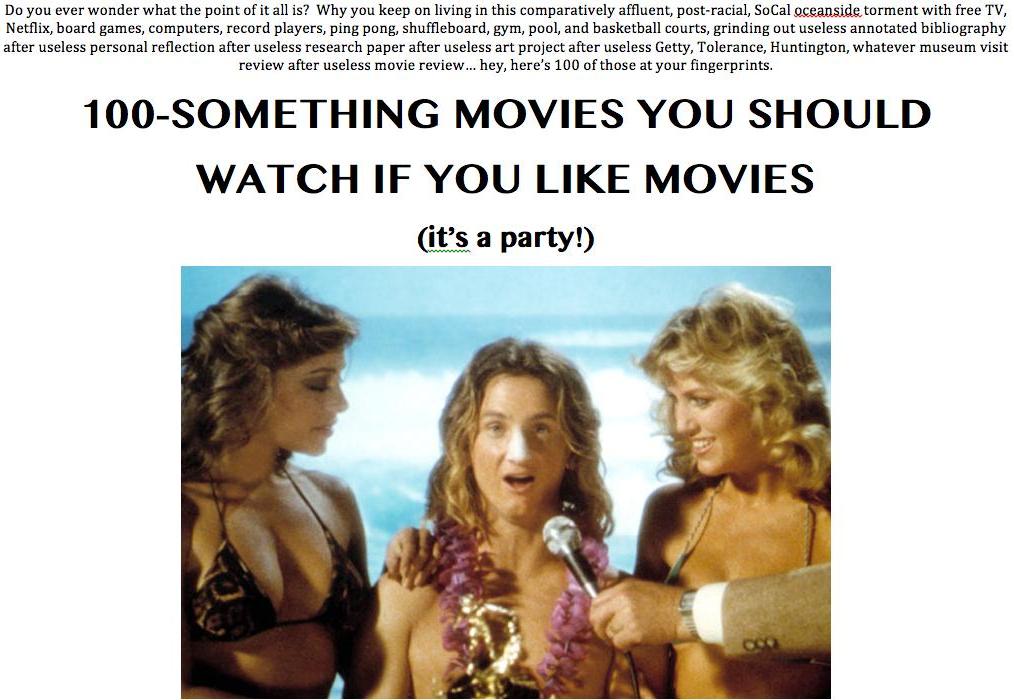
Marketing the 100-Something Movies List
Back in late November of the last year people could still say, “It’s 2015,” to justify their politics, The Author’s Files decided to run a narrowly segmented print advertising campaign targeting students of Beatissima who were preparing to turn in for the long winter and watch a lot of subpar television on their iPhones. The fliers were to be posted on the so-called “Freedom Wall” outside the cafeteria in such quantities and visual variations as were absolutely necessary to catch the attention of an extremely inattentive demographic. It didn’t work, but we put too much effort into the project to let the posters just disappear after the run. Maybe they’ll find a more understanding, cynical audience right here. If there doesn’t seem to be any binding logic or textual theme behind any of these, that was the idea, because Beatissima as an institution doesn’t think in logic or in text.




Sunday, June 7, 2015
The Garbage #2 – Did You Not Tell Them It Was The Lord's School?
Excerpted from George’s someday-to-be-released memoir about life and times at Beatissima University, featuring rare articles previously published in the Beatissima Garbage.

Beatissima Named Best
6-Figure Youth Group Retreat In Country
The U.S. News and World Report has released its influential college evaluations for the year of 2015, and Beatissima University has ranked highly in several categories, including Best Location, Most Energetic Welcoming Committee, Cutest Perpetual Virgins, and Friendliest Metaphorical Family. Indeed, surveys have shown that Beatissima students stand a smaller chance of getting racially slurred, slut-shamed, or taken advantage of in a drunken state than those at other babysitting institutions, but the celestial seaside campus received especial acclaim as the best Vacation Bible School in America.

“Convo is bea. I need to look at my feed some time of the day. #thug lyfe #hiiipower” ~ Yik Yak user
For the less introverted members of the Christian faith (although most denominations will claim that every Christian has to join with other Christians in community and figurative bodily unity), residence leaders at Beatissima also organize small Bible study clubs where more spiritual and reflective students offer interpretations of Scripture and the rest listen thoughtfully while taking notes on their phones. And then there’s the sheer diversity of worship or service opportunities happening literally every day of the week.
Citing the need for Christian compassion and charity towards “the least of these,” Beatissima’s president of intercultural assimilation, Barry Hugh Sein, said that the university will start refunding aspiring learners for the tuition they never paid in the first place. He pointed to federal policies like the earned income tax credit as predictors of the executive action’s solvency in boosting the productivity and confidence of undocumented students.
Sein issued the following statement exclusively through the Garbage:
“Undocumented students are Beas in every way except print: they go to class, they don’t go to class, they run away on weekends, they reluctantly eat the chicken tenders from the H.E.C.K. late at night, they smuggle alcohol into their dorm rooms, they complain about having to smuggle alcohol into their dorm rooms, they ask that really cute, quiet girl in the Great Books small group out on a real, one-to-one date – hell, they’re even more evolved than real Beas on that account. Cowards.
“Why should some financial difficulties have the final say on who goes and who stays at Beatissima University? After all, doesn’t our Christian mission call for us to be receiving of strangers and to love our moochers as ourselves?”
Classifieds
- Feeling horny, Need to smash right now?
- Health Center prudes won’t provide vital preventative care?
Save the drive to CVS, purchase high-quality
rubbers from unlicensed student dealer. 82% effectiveness rate guaranteed!
only $1 a pop. Facetime username ladiesman216 or text 310-318-2596.
|
Social Media Expert For Hire
Trouble
filling out 128 characters or crafting the perfect hashtag for that
Instapost? Experienced user, IMC major, can beef up your profile on
Facebook Twitter Instagram Snapchat
Tumblr Google
+ Myspace Vine
Pay
per friend/follower increase or flat payment of whatever you think a “social
media expert” is worth.
Disclaimer:
don’t understand Youtube, Wordpress, or LinkedIn. Call the office of the
Garbage. We’re not doing anything
else.
|
WANTED: useful idiots
Now
hiring vessels of the gay agenda, must wear “I support LGBT” button in public
*Qualifications:
shameless, well-intentioned ideologue. Recommended: 2 yrs public school
social studies, PS104, or equivalent, reads Huffington Post
This
is a full-time, unpaid internship. All participants will receive a Facebook
equal sign sticker for their Toyota Priuses.
Contact
Kim Took (kim.took@beatissima.edu)
|
Monday, February 2, 2015
The Garbage #1 – The M.R.S. degree and Non-Afrophobic Democrats
Excerpted from George’s undocumented and semi-autobiographical exposé Searching for Nuggets of Truth at an American University, which features groundbreaking and rare articles originally published in the Beatissima Garbage newspaper.

 Beatissima tailors courses for newer, dumber generation.
The most controversial of the revisions to Beatissima’s curricula is an accelerated, 24-unit major in Wifedom intended to supplement the equally inapplicable minor in Women’s and Having Sex Studies. Academic experts claim the program is meant to acknowledge the now indisputable reality that many women simply aren’t coming into college with the communication, workplace skills, and basic mental equipment to secure a high-paying job in the real world.
Director of admissions Sugar Colton explained to the Garbage staff that he’s “observed a lot of potential in the female first-years of class 2014. I’m thrilled to see a new batch of world-changers committed to shining a light on women’s rights and contributions in the modern world. Many of our top students have gone on to write for Tumblr and the Huffington Post. A select few talented individuals have actually found positions at Fox News and CNN, and one of our theater majors even got a physically demanding role on HBO’s Girls. I see potential in each and every one of our family, but some women have potential in different places than others.”
Another Beatissima insider named Wayne Capcall put the matter more bluntly. “69% of you Caligirls just aren’t cut out for the workplace, whether that be by alienating others with your Feminist droning, sounding dumb, or being generally, all-around stupid. But I’m sure you’re a really nice person on the inside, and even if you aren’t, some idiot will probably marry you for your outside.”
Current and potential Beas have denounced the implications of the decision, calling it insulting to their identity and deeply regressive. Valentine “Val” Hagel, a Junior Political Science major, tweeted in a series of messages, “Beatissima Housewife major reeks of misogyny. #its2015 Like, what kind of sexist, chauvinist pig do you have to be to suggest that women are good for nothing but, like, cooking and housekeeping and raising kids and stuff like that? Big B prob thinks woman shouldn’t be allowed to vote or make decisions about their own bodies, did I mention this is misognist? #yesallwomen”
Parents, however, have welcomed the addition of the program, noting it will save them a lot of money and put their daughters on a much faster track to financial independence and a respectable lifestyle.
One mother, Marge M. Acker, spoke candidly with the Garbage editor about the decision. “I was calling up my girl Julia yesterday and asking her, ‘Have you found yourself a nice boyfriend yet?’
“She was like, ‘Mom,’ and I was all, ‘Just kidding,’ and then we laughed for a while and talked about how her studies were going.
“But seriously.”
Student activists recreate non-MLK-related display for MLK Day
In remembrance of Martin Luther King Jr. and the impending demise of Oprah Winfrey’s and Michael Brown’s Oscar-nominated propaganda film “Selma”, the Racially Tolerant Caucasians of Beatissima Club held a peaceful and vaguely topical march-in at the CCB to advance the cause of African-Americans, African-English, and Kenyan immigrants in general. Black teenagers were encouraged to join but leave their arms at home, while all participants were expected to put their hands up and refrain from breathing.
Apollo Guys, leader of the club and young founder of headline-winning firm Makedown, says of the march, “We didn’t ask to be born white, and we certainly didn’t ask to bring so much social injustice down on the heads of black people, Hispanics and/or Latinos, Muslims, or other races. But we have to some extent or another created these ongoing problems and it’s our responsibility to set them straight – no heterosexism intended.”
Guys is acutely aware of the disadvantages ethnic minorities face at a school as white as Beatissima, one of which is that there are just fewer of them. “My friend Theo is the only black guy in his upper-division computer science class,” he states. “Can you imagine how hard that is for him?”
There’s also the pervasive presence of microaggressions on campus which make minorities feel excluded and different. “Theo was walking down the stairs to the Fieldhouse once when someone going the opposite direction moved to the other side of the steps. It’s insecure behavior like this that all racially nonbigoted whites at Beatissima need to actively work to check in themselves.”
Racially Tolerant Caucasians stand for a multitude of stock issues promoting the social, legal, and financial equality of African-Americans, including affirmative action, wealth redistribution, and increased funding for failing public schools. For more information, visit their page at the Beatissima Inter-Club Council’s website.
Perhaps the biggest upset of the new year was the announcement that Beatissima University is considering adoption of another set of degrees prepared specifically to meet the evolving needs and (in)abilities of Millenials. The proposed career paths have attracted derision and support respectively from students and the parents severely indebting themselves for their sake.
“I’ve observed a lot of… female first-years of Class 2014.” ~ Sugar Colton
(quote distorted for outrageousness and style)
“69% of women are Feminist or stupid.” ~ Wayne Capcall
(quote fabricated for purposes of straw man)
Subscribe to:
Posts (Atom)