Wednesday, January 9, 2013

Prometheus – The Intellectual Movie About Non-Intellectuals


This critic shall do his best to divulge no major plot details outside of this trailer and the synopsis.


Earlier in 2012, before the materialization of the fiscal cliff crisis and the whole socialism-vs.-capitalism debate, I recall begging my dad to take me to see Ridley Scott’s much-hyped Alien prequel Prometheus. 20th Century Fox had assembled several brilliant trailers that showcased the movie’s strong elements while masking its weaknesses.  I gladly would have treated myself and my friends to the movie if not for the sheer idiocy of the MPAA, which liberally hands out R-ratings to science-fiction horror flicks that have no discernible connection to reality (did you hear about the 15-year-old who sprayed toxic acid on his girlfriend?  What about the 9th-grader who hid an exotic cephalopod in her closet that devoured her when it grew into a giant carnivore?).  Unfortunately (or perhaps fortunately, as we’ll see), my dad didn’t want to see Prometheus even for free, and I didn’t feel like finding a fake parent in the parking lot, so I ended up missing my only chance to relish Prometheus, that is, on the big screen.  Although Prometheus may have entertained in the theater, it bores on a television set because its poor characterization and storytelling protrude like a slimy tentacle in Imax 3D.  Prometheus is what happens when you fuse Avatar, Inception, and a teenage slasher movie; the result is an unnecessarily convoluted and unclear plotline enhanced by pretty visuals that handsomely depict the gruesome demises of several threadbare, uninteresting characters who make ridiculously boneheaded decisions.

Prometheus opens with a series of jaw-dropping introductory helicopter nature shots, culminating in a scene at the top of a majestic waterfall.  Here we see a pale humanoid alien, apparently dropped off by an obscure spacecraft that’s rising into the clouds.  The alien drinks some kind of poisonous black goo that corrodes his DNA and causes him to disintegrate in a cool special effect sequence, the first of many to come; to our surprise, his DNA reconstructs itself at the foot of the falls, implying that new life emerges from the extinction of old.  This scene, which may be set on earth or another planet, is never tied into the rest of the film and exists for the speculation of Alien fans alone.  The next scene introduces us to the movie’s main protagonists, Dr. Holloway and Shaw, lovers and archaeologists who have discovered ancient cave paintings around the world that point to the same location in the universe.  They believe the diagrams are devoted to man’s creators, vaguely termed “Engineers”, and hypothesize that man can meet his maker by following the drawings’ directions.  Weyland Corporation deems their theory worthy of investigation, and so the CEO Peter Weyland draws up an expedition to visit the distant moon LV-223 in a starship called Prometheus.

Most of the ship’s crew remains skeptical of the mission’s basis, having given themselves over to Darwinism or materialistic beliefs.  The rest identify with some kooky creationist religion that describes the gods as material, mortal beings who created man through science and can be explained through science as well.  Dr. Shaw wears a cross around her neck but her beliefs bear not a semblance of Christianity, demonstrating the writers’ abject ignorance of her faith.  Anyway, an advanced android by the name of David accompanies the scientists on their space trip and consecutive moon romps.  Played with subtlety and deftness by Michael Fassbender, or Magneto of X-Men: First Class, David lacks a soul but turns out to be the most intriguing and multi-layered member of the crew.  After landing on the moon’s surface, the scientists immediately disembark and set out to explore a massive, hollow mountain.  At this point, Prometheus evolves from a thinking man’s movie into a haunted house flick with aliens.  One by one, the characters get killed off in creative and graphic fashions, perpetrated less by Fate and more by their own stupidity.

Prometheus would be a much scarier movie if its characters weren’t so idiotic and desperate to commit suicide.  Here’s a unspoilery example: entering the structure, the scientists find that their Engineers have been terraforming the moon, as CO2 levels are equal to those of Earth.  Apparently that’s good enough for Holloway, who promptly removes his helmet despite the protests of his companions.  Never mind the possibility of toxic chemicals in the air; anyway, Holloway lives to die another day, as well as everyone else in his party.  To be brief and spoiler-free, Prometheus’ characters continuously make decisions so implausible and stupid that their downfalls seem more forced than tragic.  Self-induced suicide is not tragedy, especially when character development is slim and acting is weak.  None of the Prometheus’ passengers besides the robot are humanized to a great extent, and none of the actors save Fassbender are capable of giving their characters life, which ironically should be an easy task, if you were to ask one of the scientists in the movie.  The Ripley role went to Noomi Rapace, who’s famous only for being exploited countless ways on camera in the Swedish Girl with the Dragon Tattoo movies.  That she can’t even scream believably in reaction to the moon’s horrors is a testament to her acting ability.  Charlize Theron, who’s received acclaim in other movies, gives an unemotional and robotic performance as the ship’s leader, Vickers, which is ironic again, as the movie suggests that she may be android.  Prometheus would still fall short of true horror even if its cast were strong.  A good horror movie will subject its audience to terrifying ordeals triggered either by accident or by believable mistakes made on the part of its characters.  Prometheus’ intrepid explorers do make several tremendous errors, but none of them are remotely credible.

The greatest criticism people levy against Prometheus is that it leaves too many unanswered questions. While ambiguous and incomplete plotlines are not a problem in essence (Inception is a superb film that leaves a couple pivotal points up to the audience’s interpretation), Prometheus’ writers and editors did a distinctly lazy job in constructing the movie’s final draft.  As I said earlier, characters act without explanation or logical justification.  I was continuously baffled as to why these brilliant scientists assumed without evidence that this new alien species must have created human life.  Nor did I understand why David’s allegiances were constantly shifting, although I suspect it could be a glitch in his system (we get no explanation).  Furthermore, the background of the movie’s Engineers and their motive are left entirely to the viewer’s imagination and speculation.  I could tolerate a little ambiguity on this subject, but forcing the audience to fill in virtually all the dots is the mark of a slothful writer.

Prometheus tries to emulate The Matrix by tackling a lot of heavy theological and philosophical questions, such as “Who created us?” “With what purpose?” and “What is the nature of life?”  Unlike The Matrix, it examines none of these inquires with much depth or clarity.  For example, David asks Holloway at one point why humans made him; the man laughs at the question as he answers simply, “We made you because we could.”  David is silent for a moment before saying, “Can you imagine how disappointing it would be for you to hear the same thing from your creator?”  “I guess it’s good you can’t be disappointed.” Though amusing, this 4-sentence conversation isn’t long enough to postulate a fully developed argument about man’s relationship to God, and the theme is never revisited in the film.  Scott raises the topic for his audience’s consideration, but drops it before finishing his point.  Immortality is brought up later in the movie, when Vickers ponders, “A king has his reign, and then he dies.  It’s inevitable. That is the natural order of things.”  The dialogue is good, but then the scene veers off to show the next victim of violence/poison, and the reason for our mortal existence is never revisited.

While the movie fails to adequately flesh out all its smaller themes, I do believe it advances a general message through the main body of its plot.  Taken holistically, Prometheus is arguably a dark satire on the folly of materialism.  The movie is an extended mockery of those agnostic scientists who believe either a) that a higher being did not create man or b) that our creator was just another material, mortal figure who had superior scientific knowledge that man too can access to create life.  The passengers of the Prometheus strive in vain to attain God’s glory and become immortals; in their confusion and desperation, they turn to worshipping earthly beings that are no less created than man.  The Engineers are not gods but mere beasts of nature that men have foolishly upheld as deities.  As punishment for the scientists’ sin of idolatry, God uses the Engineers and their biological super-weapons to brutally slaughter the crew, who realize too late that their mission, to find God and discover his ways, was futile from the start.

While Prometheus certainly doesn't defend Christianity specifically, I contend that the over-arching themes of its story are critical of earth-worship and materialism. Mr. Scott probably didn’t intend such a movie, but it’s impossible to ascertain his personal interpretation due to the storyline’s overwhelming vagueness.  The great thing about fictional works is that the audience can take away whatever message they like, disregarding the author’s intent; e.g., conservatives can enjoy The Hunger Games as a dystopia about tyranny and big government even though Suzanne Collins has said that the danger lies in small government.  Likewise, 1984 is widely regarded as a warning against collectivism and statist government, despite George Orwell’s support of socialism.  Prometheus’ viewers are free to decide the movie’s message, whether or not it aligns with Scott’s views.  The meaning is open for debate on a multitude of online message-boards.

In spite of all these flaws in its storyline, Prometheus is a visually appealing movie.  Reading about the production of the film on Wikipedia and other sites, I find that Mr. Scott deliberately kept CGI and green-screen use to a minimum, instead opting for big sets, detailed puppets, miniatures, and makeup to compose his scenes.  As a result, Prometheus’ special effects look more authentic and realistic than those of, say, Avatar or John Carter, which overused computer-generated graphics.  Scott’s team also has a mastery of digital effects, creating complex CGI holograms and enhancing landscapes to make them look more gigantic and mysterious.  The production design on the aliens themselves is great, and the final scene (MINOR SPOILER ALERT) detailing the birth of a xenomorph will send quivers across many viewers’ skin.  Prometheus stands beside The Avengers and The Dark Knight Rises as one of 2012’s most visually impressive movies, and I’d venture that it trumps the other two in originality of art design.  I must also praise the movie’s musical score, which compliments many of the scenes nicely, adding suspense and terror that one wouldn’t normally feel in the midst of such boring characters. 

Unfortunately, special effects and technical artistry do not equate to an enriching film, as Avatar demonstrated 3 years ago.  Prometheus looks good and offers an interesting performance by Michael Fassbender, but fails on two major accounts: to make us care for its heroes in peril and to properly explain the philosophical quandaries so many of them grapple to understand.  Like Elizabeth Shaw, those who watch Prometheus will still be looking for answers long after the credits roll.

Grade: B- (Where A is Inception, B is 2001: A Space Odyssey, and C is Slender)


And here is how Wall-e could have been a good movie.

Tuesday, December 25, 2012

An Anthem to Individualism


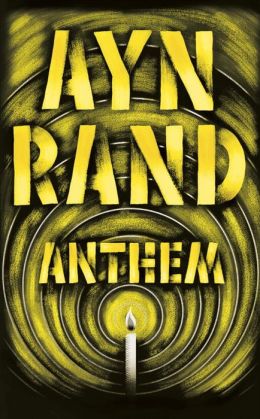
Before Lois Lowry wrote The Giver, Ayn Rand wrote Anthem, another dystopian tale that concerns a collectivist society and its suppression of individual liberty.  Both books are short and plainly written, but profoundly thought-provoking in their simplicity.

Anthem is even shorter than The Giver at a mere 100 pages, which makes it a welcome alternative for those who are intimidated by Rand’s 1000-page whale of a novel, Atlas ShruggedAnthem is unique in that it’s told mostly through the first-person plural perspective; this voice reflects the utter extinction of the individual in the story’s universe, where collectivism has so influenced society that men are now incapable of identifying themselves as singular beings, instead referring to themselves and their brothers as “we” and “they”.  The book’s protagonist, named Equality 7-2521, inhabits an unadulterated socialist community ruled by a elite class known as the Scholars, who assign to each member of the country a position at the age of 15 which they must hold until their bodies break and they enter the house of the Useless.  Equality 7-2521 has been taught to worship the body of mankind, to respect all men equally as members of the community, to faithfully adhere to the laws of sameness, and to condemn all ventures that promote individuality.  Special friendships between individuals, whether they be casual or romantic, are also forbidden, for only two entities can share such relationships that exclude the state at large, and the Scholars preach, “What is not done collectively cannot be good.”  By the time he turns 21, Equality-2521 has already committed several criminal acts, including befriending his fellow street-sweeper International 4-8818, falling in love with a beautiful woman, asking questions about science, and surpassing his peers in intelligence.  It’s only a matter of time before he tries to break his bondage to the state and pursue the prosperity long denied to him.

While Anthem contains a lot of weighty, philosophically challenging material for its brevity, it’s inferior to The Giver for several reasons.  Rand tends to be overly heavy-handed in her defense of capitalism, and Anthem comes across as especially smug.  An adamant left-winger who reads Rand will likely find her condescending, arrogant, and narrow-minded, while a dedicated conservative/libertarian will judge her style to be unsubtle and preachy.  On the other hand, the conservative themes of The Giver are only accentuated by the subtlety of Lowry’s narrative and the lack of a clearly provided “right answer” to the book’s philosophical questions.  Rand often makes the mistake of telling her readers what to believe, but Lowry never stoops to lecturing in The Giver.  On another note, Anthem feels less like a novel and more like an extended sermon on Rand’s man-centered religious beliefs.  The book consists of a thin plotline that exists mainly to convey Rand’s message about the individual and the collective.  Having reached the 200-page mark, I can say that Atlas Shrugged has far better character development than Anthem, but on the flip side Atlas is 20 times as long and the length is palpable.  Lowry, in contrast, delivers narrative and political philosophy simultaneously in The Giver, never compromising her characters or stories for a message.  To compare the two novelists with a visual analogy, Rand writes lectures and wraps them in a story, whereas Lowry writes stories and wraps themes around them.  The Giver reads more like a harmless work of fiction than Anthem, and so it’s probably been responsible for converting more liberals than its predecessor of 50 years.

Nevertheless, Anthem is a fine introduction to Ayn Rand’s philosophy of Objectivism that one could read through in about 2 hours.  It immerses the reader in a strange but frightful setting and invites one to ponder the role of a government in shaping its citizens’ lives.  75 years before our time, Rand wrote a passionate rebuke to the belief that “we are in this together”, and unless Americans heed her warning against collectivist utopia, slavery to the community is their future.

Sunday, December 23, 2012

Hellf No


An unfortunate cable mainstay that sits atop a throne of lies yet somehow stops short of showcasing Will Ferrell at his worst, this Elf can be called a credit to its race.

Thursday, December 13, 2012

The Slender experience


When my friends suggested that we socialize at a birthday party by playing a single-player computer game called Slender, I was a little skeptical.  Video games usually are not the best medium for instigating communion and fellowship, unless they’re competitive multiplayer games with motion-tracking rockets, plasma rifles, magnums, and needlers.  I soon learned that Slender is an exception to this rule.  While the independently developed horror title is a rather awful game to play alone, it stands beside Apples to Apples as one of the loudest, wildest, and most chaotic party games of all time.  I’ll let you decide whether that’s a good thing or not; I stand resolute in my hatred of Apples.

Slender is like Minecraft in that it’s a 1st-person indie game with few controls, bad graphics, and a regrettably limited storyline.  The former, unlike the latter, sells itself as a “survival horror” game and is the first of its genre that I have experienced, unless you count Halo: Combat Evolved (which threw countless parasitical zombies at me in the final half, most of which were more annoying than terrifying), Halo 3 (which had occasionally dark atmosphere and elements of horror, but also lost its effect by the final act), or Metroid Fusion (a GBA game starring Samus Aran that’s surprisingly intense and creepy).  Slender opens in a misty, seemingly uninhabited forest with few landmarks, winding roads, and a lot of crickets.  You as the player control some stranger out for a walk (my friends insist you’re a little girl, but you wouldn’t know that unless you checked Wikipedia or something, because the game makes no attempt to identify your character) who is armed only with a dim flashlight to illuminate the haunted woods around you.  Unfortunately, this is not the flashlight of Alan Wake and is incapable of inflicting damage to your foes.  The goal of Slender is to collect 8 mysterious pages scattered around the forest at various landmarks, including oil tanks, rock formations, abandoned trucks, and the infamous bathrooms.  These pieces of paper contain ominous warnings and sketches that are meant to shed light on the game’s antagonist, the slender man, a disturbing figure that pursues the player more and more ardently as the page tally increases.  The slender man, who resembles a gaunt, ghostly white, tuxedoed man with ridiculously long arms and no facial features, attacks in an unconventional manner, for he seeks to destroy not your body but your mind.  The very act of staring at the slender man makes the player’s character insane and causes the screen to get staticy.  Prolonged visual contact with the slender man will end the game in a noisy and obnoxious sequence in which the creature gets you and you meet an ambiguous demise.  If you somehow manage to beat the game by collecting all 8 pages, the slender man terminates your character anyway, as Caesar Flickerman and the people behind How It Should Have Ended explain.


The best thing to be said about Slender is that it’s free, albeit with the potential cost of a virus depending on where you download it.  The worst is that it’s a horror game which isn’t scary and relies on a gimmick in order to frighten the player.  Unless you play Slender in a dark room and mute all surrounding noises, the game fails to deliver any substantial jumps, which are all it offers even in the dark.  Slender is more startling than it is terrifying due to its lack of story and character development.  Because the game makes no attempt to personify the slender man, he is no more than a video game obstacle, like the ghosts of Pacman or the koopa troopas of Super Mario Bros.  Nor is he a scary obstacle, because his relationship to the player is unrevealed; nobody can tell you what the slender man does to your character, though numerous theories likely circulate the web.  The challenge of surviving is also nonexistent, for if you define survival as the absence of the death, Slender makes it impossible to not survive, as your character can never die.

I will say out of fairness that Slender is a very tense game that will cause many people to literally leap out of their seats, which is why it’s more enjoyable experienced with associates.  As I said earlier, the game utilizes several gimmicks to make the player jump, first of which is the foreboding heartbeat sound effect that kicks in after you find the first paper.  Slender is marked more by suspense than by action; for great periods of time you will trudge through the forest aimlessly, often running in circles, all the while having to endure the sound of your thumping heart.  The player grows so accustomed to the sheer monotony of this noise and the emptiness of the woods that he gets a serious jolt whenever either is broken by the appearance of the slender man.  Even more surprising than the sight of the slender man is the huge blast of sound he makes whenever he “teleports” to the player’s location (in reality, he never moves in the player’s vision, which further highlights the low production value of the game).  Nothing is more effective at disrupting Slender’s uneventful gameplay than the trumpet of the creature’s approach.  On top of its simplistic but unnerving sound design, the game also inspires a deep hatred of turning corners, especially in the claustrophobic corridors of the crapper.  Navigating the bathroom is in many ways the defining feature of the game, because the player knows before entering every intersection that the monster could be right around the bend; once one penetrates it, the building’s tight enclosure becomes painfully obvious.

Unfortunately, these elements are overshadowed by huge flaws, most notably the game’s pacing.  I’ve played Slender twice with a group of 10-some friends, and although we all (OK, mostly the girls) laughed and screamed together for about 45 minutes, I got so bored of wandering the forest and finding nothing that when the slender man finally did show himself, I purposefully ran into him rather than fleeing.  Slender distinguishes itself more by slow and monotonous gameplay than by true horror, which is why I rushed to end the round.  A good video game, like any book or movie, should be mentally stimulating, well-written, and entertaining in its own right.  While the reactions of various people to Slender are mildly interesting, the game itself is downright dull and unremarkable and fails to meet the basic requirements for a horror game.  For those who wish to play a truly scary game, I recommend buying Alan Wake, Metroid Fusion, any of the old Infocom text adventures (particularly the Zork trilogy and The Lurking Horror), or either of the Portal games, which are characterized not only by humor but also by dark atmosphere, suspense, and an overwhelming sense of isolation.  Although none of them are free, they offer far more fear than does Slender.

Thursday, December 6, 2012

Dictionary of debate elitist code words

Mark Steyn, the Joseph Addison of his day, has written extensively about racial code words, but no one has broached the topic of debate elitist code words.  Here are some of the many terms and phrases debaters subtly employ to make themselves sound more knowledgable/hip.  This is not a complete list; suggestions are welcome and may be added.

Brink – an extra subpoint for those unsatisfied with the complexity of 4-point disadvantages.

Calculus – synonymous with “comparison” or “weighing”.  Debaters who stink at math love this one, because they can warp to an alternate universe in which they're modern-day Euclids.

Cross-apply – synonymous with “again”.  An excellent non-response to damning arguments that sounds responsive but most often isn’t.

Dehumanization – synonymous with "bullying".  Whenever the affirmative team kills some people or takes away their benefits, the negative speaker will assert that they dehumanize the victims of their plan.

Double-bind  synonymous with "It's a trap!"  Either their bomb works and kills off hundreds of people or it fails and they kill us.  These arguments often fall under the "false dichotomy" fallacy.

Fill-in-the-blank-spec – synonymous with “insolvent”.  Flinging this text speak around will confound parent judges, but pick up college alums, who like to think they’re smarter for knowing what a “spec” is.

Framework – roughly stands for “this is the only argument that matters”.

Perm – Slang for permutation.  Synonymous with "not mutually exclusive".  More text speak that will win college judges over and alienate those judges who don’t belong to a counter-plan club.

Press – synonymous with “argument” or “contention”.  As applied to stock issues, especially topicality. 

Roadmap – synonymous with “outline” or “direction”.  Debaters often give one, but rarely adhere to it.

Shell – again, synonymous with “outline” or “strategy”, I think.  It has no strict definition that I’ve yet heard explained, but it sounds cool, so people drop it in random places.

Turn – synonymous with "The opposite is true."  Actually one of the better arguments one can make in team policy, hence the disposition of so many debaters to misuse it blatantly.