Friday, March 29, 2013

Debater's Manifesto 2012-2013 section 3

Section 3 - on criterias and evidence

* The quality of arguments is superior to the quantity.
* Saying “observation” in the 1AC is a waste of time.
* Defining the resolution terms is a waste of time (exception: if you’re purposely running a non-topical case, you should tuck a really wishy-washy, all-inclusive definition into the 1AC).
* The word is criterion, not criteria. A case with criteria is probably more confusing than necessary.
* The criteria for assigning speaker points on evidence has more to do with the debater’s delivery than with the actual quality of the evidence.
* ^ I did that on purpose.
* Heck, the criterion for all 6 categories is based mostly on delivery. In truth, one could make the stupidest arguments possible and still net a perfect 30.
* Truly fulfilling debates are shaped by arguments, not by arguments about the arguments, i.e. bickering about criteria.
* The real "real-world" criterion is Middleclass, not Net Benefits.
* Just as 2000-page bills that no one reads are detrimental to liberty, so too are 100-page "studies" that no one bothers to cite equally detrimental to debate.
* If a debater admits that his 100-page "study" has a lot of advanced, incomprehensible math which is way over his head, then it's a safe assumption that he hasn't checked the math himself.
* Source indictments are underused.
* Whether affirmative or negative, debaters must prove their own sources to be credible.  The morons of humanity far outnumber the experts, so the judge must assume all sources to be unqualified until their credentials are shown.  For all we know, militaryringinfo.com could just be an unofficial Modern Warfare messageboard.
* For all we know, every one of the New Yokel Times writers could be a brainwashed, liberal intern because literally none of them have even the slightest credentials listed on the paper’s website.
* For all we know, CNN.com reporters could be a bunch of illegal immigrants because none of them can write competently in proper English.
* Having a Ph.D. does not make one an expert. For instance, a Ph.D. in nuclear physics hardly qualifies one to lecture intelligently about strategic missile defense or drone technology.
* Strong tags represent complete, logical ideas. E.g., “Solvency – Inadequate penetration of bomb” or “Significance – aid doesn’t cause terrorism” are much more satisfactory than “Solvency – don’t solve”or “Significance – not significant”. But you can consult the common man about the last point…
* Requesting exact statistics for the results of future, aggressive action, which hinges on several variables, is an unrealistic demand of high-schoolers who have no access to classified military information, the Oracle, or magical crystal balls from divination class in Harry Potter.
* Double-turns aren't properly appreciated.  From a purely logical standpoint, double-turns are superior to single-turns because more rebuttals to an argument are more persuasive than fewer.  Even if the judge does buy that the plan improves U.S.-Iran relations, contrary to the link turn, he might still vote on the impact turn which argues that endearing ourselves to bloodthirsty, genocidal, anti-American barbarians who stone rape victims, shoot our soldiers, fund terrorists, and aim eliminationist rhetoric at our ally Israel isn't such a good thing.  The belief that double-turns act against the team arguing them is unfounded: not doing a good thing isn't the same as doing a bad thing.
* “Hi, how are you?”  “Wonderful debate we’re having.”  “OK, seeya round – I mean no further questions.”* "Judge, they completely dropped our harms, the DA, and everything else."  Lying about your opponents' speeches is not high form.
* Rebuttals are obviously for rebutting things, which means bringing up new responses to arguments instead of rehashing old ones.
* Along that line, telling your opponents which of your ludicrous, BS arguments they can answer sounds bossy and desperate.  "The man-perpetrated global warming debate is already over, so we can't consider what the temperature data and scientistically acquired findings to the contrary say."  The 1NR does this a lot.
* Analogies aren’t arguments. They’re like punching the opposition’s case, but cutting off the argument’s arms so it’s just empty rhetoric, and then they punch you back, or something like that.

Tuesday, March 26, 2013

Debater's Manifesto 2012-2013 section 2

Section 2 - advantages and disadvantages

* Disadvantages are caused by the affirmative team’s plan.  Disadvantages caused by the status quo are often called harms and are a reason to vote against the negative team, not for them.
* Disadvantages are irrelevant without a link to the case.  If a team cannot prove through logic or evidence that the plan effects the disadvantage, then the argument is void.
* War with evil governments is not inherently bad, just as peace with them is not inherently good. Impacts of war are incomplete without further analysis.
* Spending money is not intrinsically bad or wasteful; likewise, cutting spending is not inherently advantageous.  Thus, disadvantages of spending money and advantages of saving it are illegitimate without external context.
* Undermining democracy is not a disadvantage.  In the words of Thomas Jefferson, “173 despots would surely be as oppressive as one.”  Teams defending democracy must prove that a “majority rules” system of government is ideal for securing natural rights, as all the historical evidence suggests the contrary.
* Putting soldiers in danger is a truism, not a disadvantage.  The soldier’s duty is to hazard his own life for the sake of saving others’.  If a soldier flees from that duty, he loses his honor, which is a blow even worse than death; in other words, sheltering soldiers as the negative team advocates and hiding them away from a perceived threat is more disadvantageous than sending them into battle.  As the ancients said, come back with your shield, or on it.  If a soldier is never prescribed that duty of protecting his country in the first place, then he cannot truly be called a soldier, as guarding one’s homeland from foreign invaders and other threats is the very essence of being a soldier. Hence, endangering soldiers is not a disadvantage but simply an indispensable element of warfare.
* On the flip side, “protecting” troops by running away from an unstable combat zone is hardly an advantage for an affirmative case and only illuminates cowardice in the United States.
* For the negative team, lacking internal links or “uniqueness” points disqualifies the advantage.
* For the affirmative team, dropping the internal links or uniqueness of a disadvantage is akin to dropping the whole thing, unless…
* … the affirmative team argues that the negative impacts of starvation, war, losing soft power, shooting people, STDs, etc. are actually good things, in which case the plan’s disadvantage becomes another advantage and reason to vote affirmative.
* Subpoint B) of above point: this doesn’t happen nearly enough.
* “Plan hasn’t been approved” is an inherency point, not a disadvantage.  Saying there’s some reason why politicians haven’t passed the plan yet isn’t declaring the reason itself.
* Neither advantages nor disadvantages need to be quantified as long as they logically express an improvement over or decline from the status quo.  For example, strengthening the free market by promoting self-reliance and removing crony capitalism is still an advantage even though the affirmative team can’t precisely answer “how much free market” or “how much competition” they create.
* Immaterial impacts are real.
* Quelling terrorism, saving lives, and upholding natural rights are still advantages even if the plan doesn’t exterminate all terrorists, mortals still die, and rights are still suppressed.  Only a Sith deals in absolutes.
* Future harms are real.  To the best of our knowledge, Iran has not yet acquired nuclear weapons and North Korea has not taken the final step in launching them, but the lack of present chaos and widespread destruction doesn’t preclude the United States taking preemptive measures to stop a not-so-nice game of global thermonuclear war.

Saturday, March 9, 2013

Debater's Manifesto 2012-2013 section 1

Rather than writing out a boring 5 paragraph essay with signposting and transition sentences, I decided to express my manifesto on speech and debate in pithy, bite-size sentences instead.  I’ll first be covering the stock issues, then moving onto disadvantages and more general points on debate, and finally addressing – whoops, forgive my signposting.

Section 1 - The Stock Issues
* Topicality consists of 4 elements: interpretation, violation, standards, and voting issues.
* A topicality that lacks any of the above components is illegitimate.
* Topicality in the 2NC should be ignored.
* The resolution calls for a reform to the present status quo, not the future status quo.
* Substantially is an adverb, not an adjective.
* One man’s trash is another man’s substantial.
* “Resolved: that the U.S.F.G. should significantly great put an end to an evil its war presence of other nations and/or commitments.” Grammatically nonsensical interpretations are impossible to fulfill.
* The common man is lacking in intellectual sophistication, as evidenced by those who vote for Obama Phones and Obama Money.
* Foreign aid is not a military commitment.
* Banning firearms, ammunition, and other equipment reforms neither the presence nor commitments of our military.
* Extending current presence/commitments doesn’t reform anything.
* 90% of cases this season have been off topic.
* Significance applies only to the harms of the status quo and to the reform of the affirmative plan.
* Significance on numbers or percentages is illegitimate without an expressed “bright line”.  Significance with such a line is also illegitimate because the number is completely subjective.
* Significance is not a proportion.
* “Non-unique” is a prime example of the comparative numerals fallacy.  "Because the victims of the 9/11 terror attacks were only 3000 of the 100-some million lives lost in 2001, 9/11 wasn’t very significant."
* Inherency is underrated.
* The affirmative plan only has to solve for its impacts.
* The affirmative plan need not solve for any harms presented in the 1AC or external to it.  Real-world legislation is never presented with the aim of eliminating harms but with the goal of improving on the status quo.  The War on Terror wasn't initiated to purge international terrorism, an impossible labor, but to make America safer from threats like Al Qaeda.
* The affirmative team can only mandate action, not results.
* The affirmative plan need not solve for harms 10 years in the future.  E.g., thoroughly dismantling Iran’s nuclear weapons program solves for the annihilation of Israel even if Iran chooses to build a bomb again somehow, somewhere, sometime way in the future.  Killing the death tax solves for economic woes in the present even though some commie will probably reinstate it at some future time.
* After the 1AC, it’s the negative’s burden to show the plan doesn’t solve, unless...
* ... the 1AC has zero solvency evidence, in which case they've already lost.
* The criterion for solvency is Preponderance of Evidence, not Beyond a Reasonable Doubt.
* 100% solvency isn’t requisite for an affirmative ballot, as a plan may achieve its purpose even if it doesn’t completely purge the status quo’s harms.  A plan may solve if it substantially mitigates the abuses presented.  Complete solvency of any evil is an unrealistic and fantastical expectation.

* The advocacy requirement “argument” is reprehensible and faulty for at least a dozen reasons.
1st – the affirmative team acts as an advocate in debate role-play theory.  Any argument that belittles said advocacy as insufficient is an insulting and offensive smear of the affirmative team’s intelligence, and the negative team should be struck down on that rhetoric alone.
2nd – shouting down ideas that lack a given advocacy is equivalent to censorship and suppression of free speech.  The advocacy argument is thus the antithesis of the 1st amendment and is severely anti-American.
3rd – the objection neglects the Harms stated in the 1AC evidence, which represent a clear advocacy for changing the status quo.
4th – the advocacy complaint also ignores the Solvency evidence in the 1AC, which is the true determinant of a plan’s workability.
5th – good ideas are good not because someone thinks they’re good, but because they’re good in essence by virtue of proof and logic.  Good ideas are good regardless of popular opinion because reality is objective.
6th – whether or not real people approve of a certain policy’s effects has no bearing on the program’s ability to solve.  The wars on drugs and poverty have garnered widespread support from liberals and conservatives respectively, but neither has worked as originally intended.  One can make a strong case that the war on poverty has actually had negative solvency, increasing government dependency and poverty rather than alleviating it.  Advocacy does not equate to solvency.
7th – advocacy, rather than supporting solvency, actually undermines it.  Real-world advocates have crippled the U.S. economy, weakened America’s foreign influence, and run up trillion dollar deficits for the last 5 years.  When analyzing foreign policy, real-world advocates have called for appeasement of barbaric, religiously driven terrorists and for U.S. withdrawal from Afghanistan, which has historically led to anarchy, death, and the ascendency of the Taliban.  Real-world advocates are Chamberlains with no knowledge of history or capacity for logical reasoning.
8th – the entire justification for team policy debate is that real-world advocates/politicians aren’t doing their job, so the enlightened homeschool community should step in and do their job for them.   If real-world advocates were doing a great job, there’d be no need for the team policy event.  Hence, real-world advocates should not be considered necessary for an affirmative case, as their failures are the very catalyst for the debate.
9th – those who make the advocacy contention promote dependency on external opinion in the debate round, which encourages debaters to lazily lean on sound bytes and other politicians instead of fueling the debate with their own logic and rhetoric.  The ideal debate is the one shaped by the students’ own arguments, not by a bevy of elitist Ph.D.s, newspaper editorials, and other sources.
10th – clinging to outside sources and opinion negatively impacts the educational value of debate, which stems from developing students’ deductive reasoning and eloquence of speech.  A fine example of this effect is the Aristocracy argument levied against the death tax case from last year.  The entire basis for this disadvantage was a citation from a BYU professor on Canadian politics, who said that repealing the tax would end democracy as we know it (I’m down with that) and let the rich take over the universe.  Negative speakers never had to articulate a syllogistic and sensible argument supporting their point because they had a seemingly credentialed advocate who made their point for them, albeit without a logical procession of thought.  On the other side of the table, the affirmative team would boast about how many think tanks, businesses, and conservative politicians advocated death to the death tax, but such arguments were also lacking in logical depth.  Appeal to authority is fallacious and detrimental to education.
11th – what the Dell is an “advocate”, anyway?  Must he be a qualified expert in a field related to the case, an officer in the military, an intern majoring in military strategy/history, or just a loyal New York Times customer who tweets low-information news to low-information voters around the nation?  The definition of an advocate is completely subjective and worthless.
12th – the word “advocate” does not appear in the team policy rules, hence the affirmative team should not lose for excluding one.
13th - negative teams making this point often fail to give an advocate for the status quo.  This is hypocrisy.

* “No empirical success” isn’t a solvency argument.
* “Empirical failure” is.
* “No numbers” isn’t a solvency argument.
* “Terrorism/illegal immigration/unemployment/debt/crime/sin etc. still exists” isn’t a solvency argument.  If it was a legitimate point, then all plans to mitigate the above abuses would have to be discarded as insolvent because no government will ever totally eradicate crime.

Tuesday, February 19, 2013

I want to see you be Brave – "want" being the key word.


I thought Pixar had made some pretty abysmal movies in the past; pictures like Toy Story, Finding Nemo, Ratatouille, and Wall-e seemed inexcusably bad, deplorable to the point of being painful.  Then I saw Brave, which if nothing else has taught to me to appreciate the good attributes in Pixar’s other abominations. Most critics who’ve jumped on the elitist Pixar bandwagon* have criticized Brave for failing to match the studio’s former standard of quality, but they miss the point: Brave is the quintessential Pixar production, distinguished by forgettable music, corny writing, poor animation, and clichés.  It doesn’t miss Pixar’s usual standard, for it is the standard that all its predecessors save a few have matched.


Brave’s trailer wonderfully condenses the movie’s richly thought-provoking themes of mutual existence and understanding, feminism, and “changing your fate” into a 2-minute timeframe.  Adding a couple bears, magic spells, some potty humor, and a lot of bad slapstick to this formula yields a 3-minute plot stretched over 90-some minutes.  Brave centers on an aloof, redhead princess and her quest for independence, namely from her domineering mother who’s desperate to get her hitched.  Merida loathes the life of a noblewoman and yearns for freedom from her position’s chains – sorry, I meant to say shackled.  She cherishes the moments when she can ride her horse, scale mountains, and shoot arrows in the woods, but her parents have regulated these opportunities after an attack by a vicious bear in Merida’s youth. Eventually, the queen decides to hold a championship for her daughter’s hand.  Suitors gravitate to the kingdom from all over the land, but Merida will entertain none of them as options, so she runs away.  She stumbles upon a forest cottage that belongs to a witch, who gives the girl an enchanted pastry that will “change her mother”.  Giddy with excitement, Merida returns home to “change her fate”, but the spell doesn’t work as she originally intended.  It changes her mother… into a cheesy-looking black bear.  Would that Merida had heeded the old adage: all magic comes with a price, dearie!  Thanks to her impetuous meddling, she and her would-be-funny younger brothers must spirit their mom out of the house, as the king is unlikely to be receptive of Merida’s story.  “Spirit”, however, may not be the proper word, because the grand escape takes around 10 minutes and a lot of forced physical humor.  Somehow the whole experience of being turned into a bear and almost killed by humans actually endears the queen to her daughter, and together they end up ridding Scotland of Mordu, the realm’s resident monster dragon – bear, that is. Mother and daughter learn to respect each other for their differences, and somehow the queen turns back into an ogre with the sunrise.  Woman, sorry.

Brave’s biggest flaw, besides ripping off ideas from better movies, is that it makes no logical sense.  Merida disrespects her elders, runs away from home, mingles with a total stranger and witch no less, poisons her mother, almost gets her killed, and never apologizes properly for any of it – rather, she pulls a Democrat and boasts of her numerous misdeeds, claiming she was misunderstood/taken out of context and that her actions were justified because she hoped to change her fate (sorry, I couldn’t resist).  If you look at the full context of her situation, it’s pretty clear why she transfigured her mom into a bear.  Anyway, all of Merida’s misdeeds, far from further infuriating her already incensed mother, have the opposite effect of what one would anticipate, drawing the two together rather than dividing them for the rest of time.   The crux of Brave’s story has no logical cohesion.  Even more gravely, the writers never make a serious attempt to highlight the imprudence of Merida’s disobedience.  Instead of trying to craft a moral about honoring one’s father and mother, Pixar opted to deliver unnecessary and unfunny slapstick and to characterize the movie’s adults as either blundering idiots or narrow-minded, tyrannical control freaks.  With movies like Brave acting in conjunction with corrupt government schools, there’s no mystery as to why this century’s children are a bunch of arrogant, entitled brats who knock themselves up and reject any wisdom their parents have to offer.

Most critics have lauded Brave for its beautiful computer animation, but even that aspect is overrated. Shrek, Kung Fu Panda, How to Train Your Dragon, Up, Rango, and – I hate to say it – even Wall-e are all older than Brave, yet feature superior art design, textures, lighting, and character animation.  The animators of those films brought their subjects to life through a diverse array of emotional expressions and created digital actors that in many ways rivaled real people for authenticity.  Brave’s CG cast is cartoonish in comparison.  E.g., Merida and her mother convey around 4 emotions throughout the film: exasperation, anger, fright, and, in the daughter’s case, mischievous joy, all of which are overstated and incredible.  That the flashy, talking motor vehicles of Pixar’s Cars are more believable than the human beings of Brave says a lot about the latter movie’s quality.  As for the omnipresent bears, they’re neither intimidating nor cute nor realistic.

If you are desperate for a girl power movie with a strong female protagonist that young girls should emulate, then I would recommend watching Disney’s Chinese adventure Mulan, the Rapunzel retelling Tangled (OK, not really a “girl power” movie, but endearing nonetheless), or the more violent dystopia The Hunger Games, although the film adaptation has its own share of moral quandaries.  The stop-motion fantasy/horror movie Coraline is another story that concerns a young girl’s rebelliousness and desire for an “other mother”, but unlike Brave it tries to illuminate the negative consequences of disobedience and taking one’s parents for granted.  All these movies have plots that make sense and, possibly excepting The Hunger Games, good morals.  Brave possesses neither of these elements, but it is a definitive Pixar movie, so those who enjoyed such cinematic masterpieces as the Toy Story trilogy will probably admire Brave as well.  Those who care about things like a compelling narrative, intelligent dialogue, and a meaning will have to look elsewhere for entertainment.

Grade: Bearly worth your time

The Author's hierarchy of Pixar movies
The Incredibles (A)
Up (A-)
Cars (B+)
Short films (B+)
Monsters Inc. (B)
Ratatouille (C+)
Toy Story 3 (C+)
Toy Story 1&2 (C-)
Finding Nemo (C-)
Wall-e (D+)
Brave (D+)
Can’t remember Bug’s Life. 
Never saw Cars 2, but from what I’ve heard it’s a long commercial for Chevy Volts.

* The Pixar bandwagon: the accumulation of all those self-inflated snobs who fancy themselves more intelligent because they have the capacity to understand a children’s movie and recognize the deep themes allegedly inherent therein.  Pixar fanatics will often describe a cartoon like Toy Story 3 as a “film for adults more than kids” with mature themes and emotional impact, not so much because they believe it as because they’re afraid of being the dissenting voice on a supposedly flawless piece of art.

Sunday, January 27, 2013

Halo 4 – A Testament To All Microsoft's Sins


Taken on its own as a standalone product, Halo 4 is not the worst video game I’ve ever played, but when one considers the legacy traced out by its Forerunners, the newest Halo Installation stands alongside The Phantom Menace as one of the entertainment industry’s biggest letdowns in history.   After completion of the excellent prequel Reach, the series’ creator Bungie appropriately called the story a wrap and surrendered the wheel to 343 Industries, which is fast proving itself to be a drunken driver.  Halo 4’s story is a convoluted and incomprehensible mess marked by corny dialogue, dull pacing, bad editing, and lackluster character development.  In seeking to raise the pathos of the campaign, 343 wrecked the emotional impact of the story; in trying to tell a compelling sci-fi epic, they stripped the story of logos.  The game is a massive disappointment overall, and signifies the rampancy of the new trilogy.


The game opens 5 years after the perfectly satisfying conclusion of Halo 3, wherein (spoiler to all those cavemen who haven’t completed the trilogy) Master Chief saved the universe from the Flood by prematurely firing a Halo ring above the Ark, thus destroying the parasite, and inadvertently split his ride off the world, the UNSC cruiser Forward Unto Dawn, into two parts.  The Chief’s half drifted off into uncharted space while the Arbiter’s side arrived at Earth, where humanity gave the Spartan a reverent 21-gun salute and most declared him dead.  “Were it so easy.”  In reality, Chief entered cryo sleep and told his endearing A.I. companion Cortana, “Wake me when you need me,” which she eventually does after the ship’s systems report a breach on multiple levels.  The once-dynamic duo soon identify the invaders as radical Covenant forces, leftovers from the war whose arrival at F.U.D. is never really explained.  The Chief executes the aliens only to have his ship be sucked into a gravity well originating from a metallic Forerunner planet called Requiem.  Cortana’s rapidly ailing condition complicates matters: A.I.s start to deteriorate 7 years from their enlistment, undergoing a process called rampancy, which ultimately causes the programs to “literally think themselves to death”.  The only way Chief can prevent his friend’s demise is to locate the donor of her DNA, who in Cortana’s case is Dr. Catherine Halsey, the mastermind behind the controversial Spartan program.  Halsey played a significant part in the Halo novels before her debut in Reach, and although she appears momentarily in Halo 4’s opening cinematic, the scene is never tied back into the rest of the game. Before he can return Cortana to Halsey, Chief has to overcome several hurdles including a dastardly Forerunner villain (equivalent in position to the Gravemind or the Prophet of Truth, but not as interesting), swarms of Covenant and Prometheans (did the Greeks ever foresee the Titan’s immense popularity in American pop culture?), and a lot of irresistible buttons.

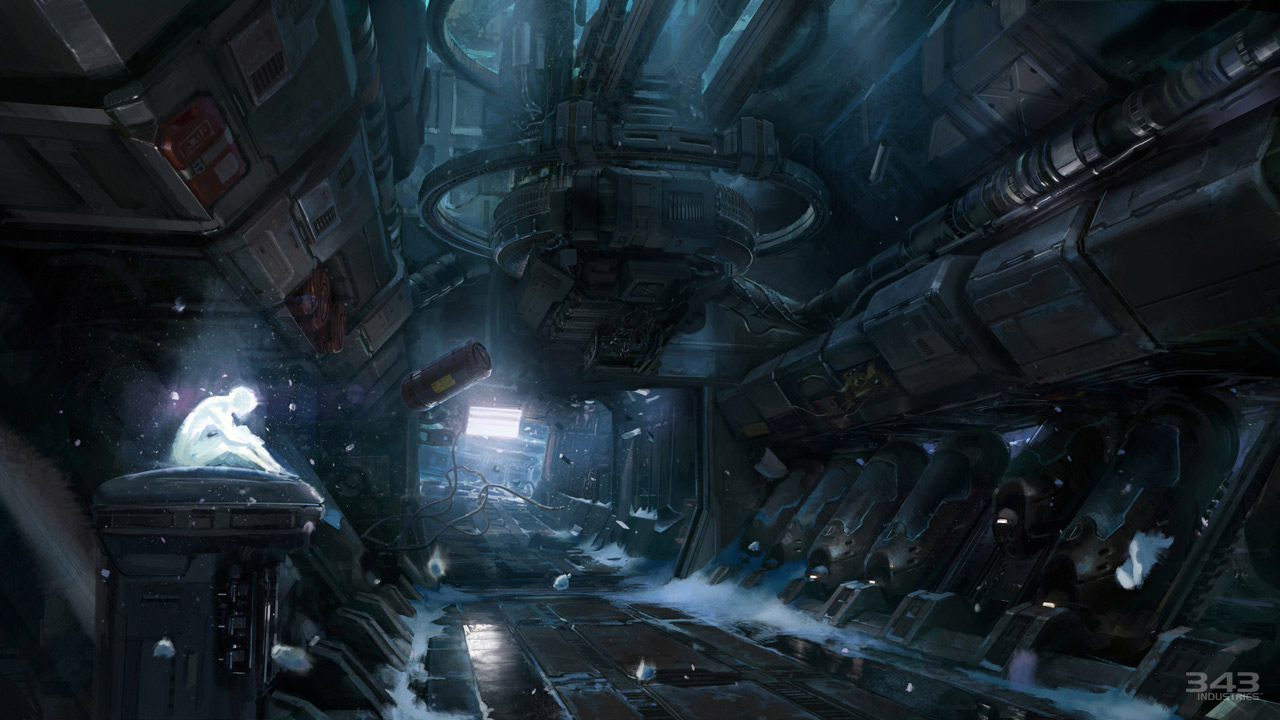
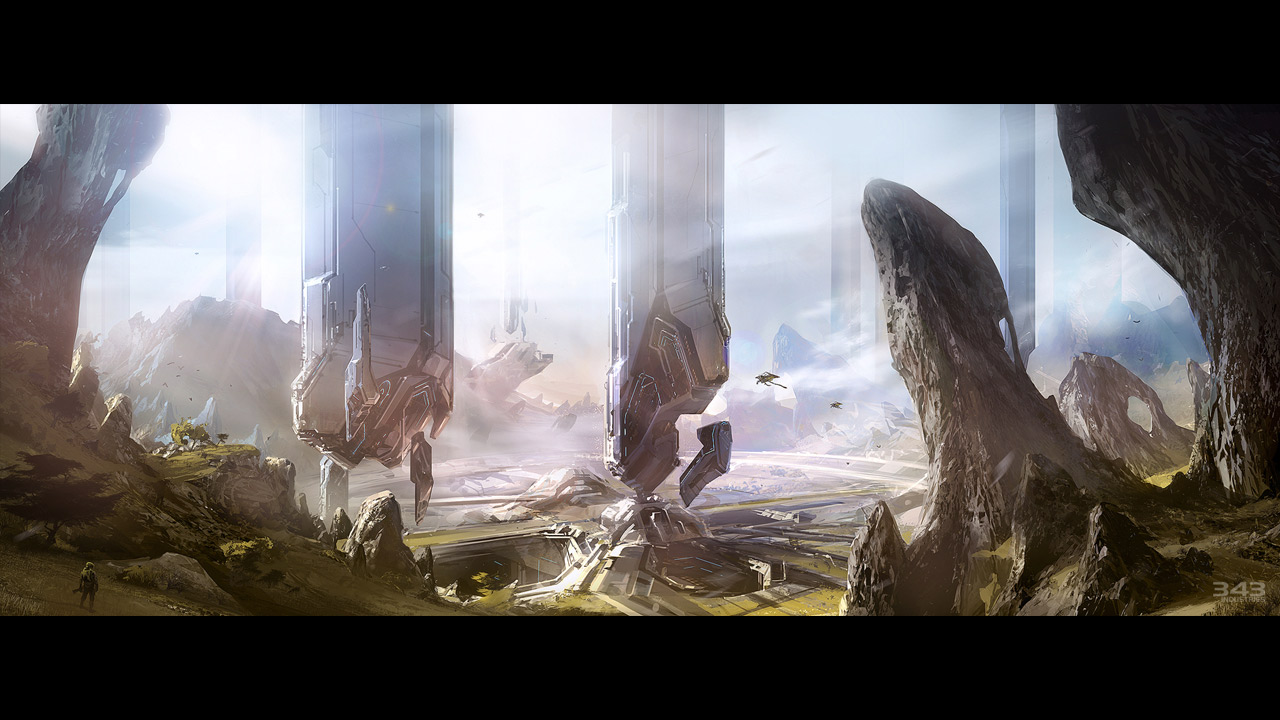
Before I proceed to lampoon almost every aspect of Halo 4’s story and gameplay, I must give what little credit the game is due.  Neil Davidge’s musical score was far better than I anticipated; he’s not the equal of Martin O’Donnell and Michael Salvatori, but his work still retains the grandeur and mystery that Halo’s music has always conveyed.  The CD of the soundtrack is sadly incomplete, but I’d recommend purchasing it anyway, or at least the following tracks: Awakening, To Galaxy, 117, Arrival, and Revival.  It’s a distinct departure from the sound of Bungie’s games, but memorable and exciting nonetheless.  The sound effects on the weapons and vehicles are commendable, per norm.  The motion-capture animation, especially on the faces, is superb but for some occasional lip syncing issues.  The game’s art design is also impressive, although it steals from Tron, and Requiem’s appearance captures the majesty of Halo’s other environments; unfortunately, its impact is marred by unbearable gameplay and an atrocious narrative.


* Spoilers from this point on until further notice, but for $60 the Xbox owner deserves to be spoiled/warned beforehand.

Halo 4’s worst attribute is probably its storytelling.  The plot is incomprehensible from the moment we first see the Covenant and just gets more confusing as the main villain is revealed.  Many questions are unanswered, as in Prometheus, and the writers assume that players will absorb many details which are never formally disclosed in the game.  An early example of this is the entrance of the game’s antagonist, who characteristically delivers an evil monologue while force-choking the Chief before hurling him to the ground with force-push.  John gets to his feet and runs away, but a white light flashes behind him, somehow warping him to a completely different scene without any explanation.  As if the level wasn’t unclear enough already, Cortana pipes up and says that Chief “has to stop that Didact,” even though the creepy armored guy never provided his name.  In fact, the Vader wannabe never supplied so much as an introduction, a motive, or an evil agenda, spewing only cryptic nonsense like, “Time was your ally, human. It has abandoned you.”  The Didact is just another generic, one-dimensional, Hollywood bad guy with no real purpose other than to scan things inquisitively with his orange sci-fi laser and vaporize random humans senselessly.  Religious zealotry drove the Covenant, irrational duty and utopianism the Oracle (that is, 343 Guilty Spark), and natural instinct the Flood, but the Didact has no motive.  He merely epitomizes the lack of complex, believable characters in Halo 4.  Nevertheless, Cortana and Master Chief somehow perceive a deeper side to the villain and know all about his plans right off the bat.  Indeed, our two heroes always seem to be one step ahead of the gamer.  After another especially confusing cinematic later in the game, Chief remarks to Cortana, “I know what the Didact wants,” but never bothers to elaborate for her enlightenment or the player’s.  It’s as if 343i knew the story they wanted to tell but couldn’t transcribe their ideas into a legible product.  Eventually the two companions run into some UNSC troops from the vessel Infinity.  Not only do the writers neglect to establish clearly why Chief has close friendships with certain members of the ship, but they also leave unclear why the crew is so unsurprised that the legendary Spartan is alive and well.

Perhaps there’s a novel you can buy that explains it all, but Halo 4 itself is an unsolvable mystery, a unforgivable smite against the consumer given that the preceding games were all self-contained works that one could enjoy without possession of any outside knowledge.  To describe the new Halo in one word, the campaign feels woefully incomplete, like an unfinished draft that was never submitted to beta.  Plot holes abound and the story is fraught with abrupt scene changes.  At one point, John gets transported inexplicably from an open, gray, Library-esque chamber to an indistinct, heaven-like place where he receives a garbled, utterly indecipherable history lesson about the Forerunners from a ghostly woman called the Librarian.  Chief speaks to her as if they’ve had a long-running relationship and effectively excludes the player, who doesn’t know the Librarian, from the conversation.  The game’s writing is plagued with conceptual issues like this: the player cannot be immersed in the story if the character he embodies has ulterior knowledge that isn’t shared.  Good video games, especially 1st-person ones, follow an initially ignorant character who absorbs information throughout the story and grows in knowledge ALONG WITH THE PLAYER.  Portal, Knights of the Old Republic, and Bungie’s Halo are all story-driven games that have used this approach to great effect.  Halo 4 takes the opposite route by focusing on characters who are perpetually smarter than the person with the controller, and thus the plot makes no sense.

Clarity isn’t the only issue bogging down Halo 4’s storyline.  343i stated that they wanted to increase the drama of the game by “drawing out the humanity” of Master Chief and further delving into his relationship with Cortana.  There are several problems with this: first of all, the studio tried to fix a system that wasn’t broken.  Nobody to my knowledge cared that John was just an emotionless, indoctrinated supersoldier in the Bungie titles because that’s all the original story required him to be.  The first Halo trilogy was never supposed to be a “character analysis” of troubled individuals, but an epic, good-vs.-evil space drama like Star Wars where action, conflict, and mystery drove the plot.  There was a layer of character development present in the Bungie-developed games, but the writers conveyed it subtly without ever compromising the plausibility of the larger narrative or its emotional impact.  The old Halo games delivered drama impeccably, and Halo 4 goes astray precisely because it tampers with the original formula and tries to forcibly inject “soul” into characters who didn’t need it or already had it.  343i’s efforts to mend the franchise only result in a sloppy and awkward love story between a faceless metal man and a computer program.  The love subplot of ODST demonstrated just how incompatible Halo is with romance, and 343i’s escapades into the genre fare even worse than Bungie’s.  The romantic dimension is introduced early on and only gets more excruciating as Cortana evolves into the damsel in distress and becomes increasingly reliant on Chief’s comfort, reassurances, and periodic dates.  “Come on, Chief. Take a girl for a ride,” she says, exhorting the Spartan to take a Pelican for a spin.  How dialogue like this ever got approved is beyond my comprehension.  Here’s more: “*Sniff* You’ll be given another A.I. partner, maybe another Halsey model. *Sniff*.”  “That’s NOT going to happen.”  Critics have hailed Halo 4’s love story as emotional and tear-jerking, but few have had the courage and/or intelligence to state the truth of the matter, which is that the new boy-girl dynamic is poorly executed, unnecessary, and forced.  Halo 4 is just more proof that love stories don’t belong in the majority of video games.

To top things off, the story is completely implausible, as evidenced by the ending.  In the lead up to the final boss battle, the player will die about a dozen times at the hands of generic minor opponents armed with light firearms.  However, when the Chief finally does press the last button in the game and face off against the Didact, he not only endures the awesome force powers of the villain, who predictably gives another indulgent monologue that grants Cortana enough time to attack him, but he also survives a nuclear explosion which rends the Didact’s giant metal ship asunder.  Presumably Cortana saves him with a fireball-proof forcefield, but the script doesn’t make the conclusion very clear.  All we know is that Master Chief evades atomic death to press more buttons and rescue his girlfriend in another game.   Or maybe Cortana is gone for good, a probable scenario given the incompetence of the writers and their propensity to introduce and eliminate characters within the same level.  Whatever the case, one can be reasonably certain that players will cross paths with the Didact again, as the after-credits scene illuminates that he too was able to survive an explosion which would tear his very atoms apart.  “The Reclamation,” he laments, “has already begun.”  Alas, it has not ended.

* Spoilers exeunt.

Regardless of the story’s flaws, the gameplay itself is painful and feels like something out of an Atari 8-bit classic instead of a 21st century blockbuster game with a $100M budget.  Former Halo games have been distinguished by challenging enemies, diverse level design, and story-driven objectives.  A particular level in Reach has the player fight through a bunch of suicidal aliens, rescue some civilians, defend an elevator, jetpack through a massive city to reach a landing pad, clear it, hop in a Osprey-like helicopter, ride it to a beach while gunning down bad guys in a turret, activate two missile batteries, and fire them to drive off the Covenant’s cruisers.  Bungie’s Halo rarely subjected the player to tasks which seemed unnecessary to advancing the story, and thus the original games had a cinematic quality to them.  In contrast, Halo 4’s objectives seem more like menial time-fillers than a means to progress a plot.  A typical Halo 4 level goes as follows: run through a portal, follow a trail, get ammo, enter a large, open area and dispatch 50 bad guys, destroy 3 energy orbs/generators, move on to the next area, press a button, jump through another portal, follow another oddly familiar trail, reload, kill 50 more bad guys, destroy 3 more objects, press another button, jump through one more portal, kill 50 bad guys as you go through the same room twice, and press one final button.  I would estimate that 90% of the time Master Chief is fighting through bad guys to press a button or destroy something that’s blocking his path. Almost the entire storyline, including the final boss battle, is directed by the necessity of plugging Cortana into some circuit so she can scream and wail while flashing red.  “Plug me in, Chief,” and “Pull me, Chief,” alone comprise a good portion of the game’s script (think “Wall-e!” and “EEEVAAAA!!!”).  The level design is simply a disgrace to the series and gives new meaning to the word monotony.

If the actual layout of the campaign wasn’t bad enough, the player also must suffer through a deluge of bad programming.  Halo 4 retains all the original Covenant from CE and introduces 3 new enemies called Prometheans.  We have the grenade-happy, teleporting Knight, who represents the elite of his robotic clan, his ferocious hellhounds, which have guns for heads, and the watchers, flying thingies with weak firepower but powers of resurrection and shielding.  The Prometheans substantially increase the difficulty of the campaign, but for all the wrong reasons.  Instead of being smarter or stronger than the Covenant, the Prometheans just cheat, whether by warping to another area so they can heal or by reviving each other after Master Chief kills them fair and square.  Master Chief has neither multiple lives nor the ability to teleport, so it would seem that the Prometheans have an inherent, unfair advantage over the player.  Fortunately, or unfortunately depending on how you view it, this advantage is unbalanced by the atrocious artificial intelligence.  The computer-controlled opposition in former Halo games was always intimidating because the aliens were intent on the player’s annihilation.  The Covenant worked cooperatively and aggressively to halt the Chief’s progress; they were a force to be reckoned with, and the difficulty stemmed not from a scarcity of checkpoints but from the struggle to reach them.  The Prometheans and the new Covenant are either incompetent or passive in dealing with Master Chief.  Enemies often run around in circles aimlessly, firing a few rounds at the player before turning in the opposite direction and running away.  This is especially true of the mechanical pups, which hop all over the place like coyotes.  Sometimes the enemy will empty several magazines on the Chief only to forget about the Spartan entirely when the player ducks behind cover for a certain period of time.  Promethean Knights will fire on the player until he hides, then return to their long back-and-forth patrol routes, which is basically their way of begging to be assassinated.  Other reviewers have noted the inability of the A.I. to properly gauge distance and make logical decisions based on it.  The bad guys, both Covenant and Forerunner, tend to use every gun at their disposal as a sniper rifle, firing short-range pistols, automatic weapons, and shotguns at the Chief even from a hundred yards away.  The stupidity of this behavior is nauseating.  The developers at 343i also deemed it prudent to make the “catch” skull a permanent feature.  The automatic impulse of any Knight or Elite upon spying the player is to throw a grenade.  The second thing on its mind is to throw a grenade.  If the Chief is still alive, the alien will charge/warp at him and finish the player off with a melee.  For a 1st person shooter, Halo 4 offers a startling lack of shooting on the part of the bad guys.

Several guns, armor abilities, and a new vehicle were added to the game, but few of them are unique or fun to wield.  Some weapons, like the Promethean pistol, the Covenant beam rifle, and especially the sucky (pun intended) forcefield grenade, are next to worthless, while others are effective copies of each other (battle rifle, DMR, carbine, light rifle).  Small vehicles are once again prone to crashing and flipping, and the new mechwarrior does little to freshen the repetitive gameplay.  New armor abilities include an autonomous portable turret, a boost pack, the hardlight shield (temporary Promethean version of the jackals’ signature equipment), and x-rayish Promethean vision, a pointless addition that’s thrown in just for the sake of a foggy sequence in one level.  The turret proves most invaluable during the campaign, sparing the player a lot of tedious killing, but it’s a boring alternative to tools like active camouflage, a jetpack, or holograms, none of which are an efficient means of beating levels.  The only improvements in Halo 4’s gameplay I can fathom are that sprint is now permanently mapped to a button and that absorbing fire no longer takes the player out of his scope while sniping.  Even these changes are unnecessary and could be rectified with smaller levels, more ammunition (and hence less scavenging), and smarter enemies who don’t snipe with plasma pistols.

Other reviewers have been nearly unanimous in their praise of the game’s graphics, but I actually think they’re a step down from the visuals of Halo 3.  While Halo 4 for the most part has better textures and more detailed character models than its predecessors, it falters in its particle and physics effects.  All the other Halo titles on the 360 have borne acclaim for their explosions and physics programming; when a vehicle exploded in Halo 3, it fragmented in a burst of detailed flames and many pieces of debris would continue to fly in the direction the vehicle had been traveling.  The trajectory of objects was influenced by inertia, such that the destruction of an overhead banshee or a speeding ghost could result in a second death if the destroyer doesn’t avoid the flying wreckage.  Halo Reach and ODST particularly had animation that could rival the special effects of a summer blockbuster.  Explosions in Halo 4 are dull and unremarkable in comparison.  In fact, the game’s explosions are so lackluster that the cutscene directors deliberately avoid animating them wherever possible.  No fewer than 5 times in the game, the screen will fill with white light right before a devastating crash or explosion, conveniently eliminating the need for an awesome CG effect. The CG effects we do witness are pathetic.  For instance, when one blows up a large alien dropship, it will form a small pink blast then split into 2 or 3 round chunks of metal that bear no resemblance to the original vehicle, whereas in Halo 3 the same ship would divide into many distinct pieces that the player could mentally piece together into a complete Phantom.  Halo 4 discards the built-in inertia of former titles: a hovercraft in motion stays in motion unless the player kills it, in which case it will drop to the ground magnetically.  Gone also are the so-called ragdoll physics of the later Bungie games, wherein the A.I.s would fall and fly according to the location of projectiles and nearby detonations.  Halo 4 chooses instead to emulate Combat Evolved, where enemies had a total of 2 death animations each, yet the Prometheans lack even these, simply dissolving when killed.  I must also nag about Cortana’s redesign.  The character had formerly possessed a feminine grace and maturity of appearance that overshadowed her somewhat provocative garb, viz. nothing.  343i’s Cortana looks and sounds less like a lady and more like a whiny, emotionally distraught teenager who obsesses over her vanity.  That the studio rehired Jen Taylor to voice the character doesn’t mask the banal dialogue and obnoxious voice distortions that escalate with her rampancy.

                                   Cortana 3 vs. Cortana 4


Aside from ruining the campaign, 343i also regressed by removing the Firefight mode and fundamentally altering the competitive multiplayer.  The Firefight replacement, Spartan Ops, is intended to build on the game’s story, but in reality the short episodic missions just rehash maps from the campaign, rearranging the layout of enemy forces and adding waypoints.  The level formula is cut and paste from the campaign, which means you’ll be pressing a lot of buttons and killing a ton of bad guys to reach them, except you’ll be playing as a generic Spartan nobody instead of the Chief.  Firefight was fun in ODST and Reach because it was a simple, arcade-like alternative to the story; Spartan Ops tries to replicate Halo 4’s miserable campaign, and suffers as a result.  It also baffles me why Microsoft would limit this service to Gold members of Xbox Live, for the player can undertake the Ops solo as well as with a team.  The multiplayer also got an unwanted “upgrade” which completely reverses the former principles of equality that guided the matchmaking experience.  In classic Halo, all competitors started on equal ground with the same selection of weapons and armor abilities.  Apparently 343i thought this concept was outdated, so they redesigned the multiplayer to better reflect the class warfare of modern politics.  Now Spartans receive level-ups and experience points which they can spend on better weapons, upgrades, and abilities.  The more you play, the more points you accrue and the easier you can pick on newbies who start with the puny assault rifle and magnum.  Thanks, 343i, for fixing another unbroken system.  Heaven forbid that the series’ developers solve a real problem, such as the inability to toggle friendly fire for team-based games online.

In sum, Halo 4 is a colossal bore and a testament to all Microsoft’s sins.  Some will still play it out of nostalgia for the good old days of Cortana and Master Chief, but to those who pine for another adventure of Bungie’s caliber, one thing is certain: “Halo… it’s finished.”

Grade: C or 4/10