Sunday, October 28, 2012
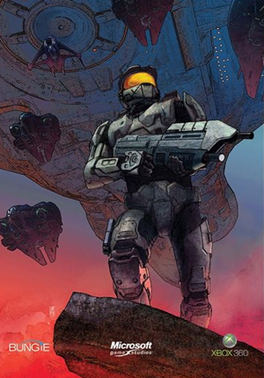
Comic Review: Halo Helljumper
Definitely a step above its forerunner (pun intended) Uprising, Helljumper is a worthy adventure for Halo fans who liked ODST. Spread across 5 issues, it covers an earlier mission of two of the game’s heroes, Dutch and Romeo. The novel opens with a distress call from an arid human world called Ariel; the ODSTs are summoned to investigate the situation. Landing on the surface of the planet, they’re puzzled by a startling absence of human life, finding only one corpse that seemingly died from fright. Entering the underground facilities of the planet, they happen upon several platoons of Covenant forces, commanded by several relentless Elites. In the violence that ensues, Dutch and Romeo are separated from the rest of their squad and forced to unravel the devious schemes of the Covenant on their own, confronting legions of enemy forces all the while.
Helljumper will certainly entertain the reader, though it will not educate him. The writer, Peter David gave the briskly paced story a heavy does of action and mystery that does justice to the original game. Its central characters prove themselves adept in many kinds of combat, from planting mines to kamikaze-crashing Covenant dropships into their foes, but they also possess a resolute fraternal bond that no hostile threat or amount of bickering can undermine. The book replicates the game’s themes of courage and camaraderie quite well, a feat that Uprising failed to achieve. It also has some good comic-book one-liners:
“While you’re looking, also see if you can find either civilians or hostiles. You know which ones to shoot, right?”
“This is ridiculous – our platoon is god-knows-where, presuming they managed to clear the blast --- there’s Covenant running around, civilians are missing and maybe being tortured --- and I’m playing twenty questions with a grunt?”
The book’s artwork, by Eric Nguyen, is also impressive, if not completely unique; the ODSTs are drawn well and the Covenant soldiers are exceptionally portrayed as the fearsome menaces they represent in the games. Stronger and swifter than their human adversaries, the Elites are no pushovers in this book, as Romeo and Dutch deduce the hard way. Battle scenes are complemented with a good deal of purple blood and gore, so much at times that it seems excessive, but the intensity of ODST’s combat is captured nonetheless.
The book fall short in some areas, the most notable flaw being an awkward subplot involving a relationship between Dutch and a female member of his squad, a relationship so strong it induces Dutch to request withdrawal from the UNSC when his special friend gets injured and has to leave the military. If anything, this functions as a compelling argument against sexually integrated armies. It’s also regrettable that the novel only probes the background of Dutch and Romeo, neglecting to incorporate any of ODST’s other characters, such as Buck, Mickey, or Dare into the plot.
Overall, though, Helljumper is a quick and fairly enjoyable read that should be embraced by fans of the Halo universe. It’s not a terrific graphic novel and the $20 retail price is too high, but for $10 it merits a look.
Friday, October 26, 2012
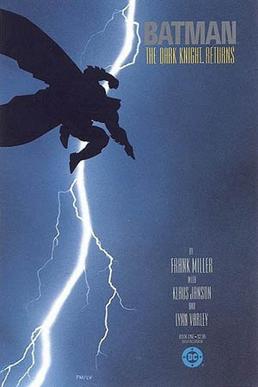
Comic Review: The Dark Knight Returns
If there were a prize for the most overrated comic book, The Dark Knight Returns would claim it with little competition. Frank Miller’s long and incomprehensible story about Bruce Wayne’s return from retirement is fraught with mutant gangs, nuclear warheads, exploding dolls, topless Nazi-girl thugs, drive-by news reporters, and middle-aged crime fighters who never stop whining about how old they’re getting. It’s a mess.
The premise of the novel is that the ascension of a new criminal gang called the mutants prompts a middle-aged Bruce Wayne to don the Batsuit again after a ten-year withdrawal from vigilante work. As if the mutants weren’t a big enough burden, he also has to foil the evil plots of Harvey Dent, who has undergone an external but not internal recovery from the accident that left him disfigured and wrathful. Batman’s age cripples his ability to fight the terrorists of Gotham, but a teenager girl with her own Robin costume enthusiastically offers to assist him in his war on crime. While some in Gotham are pleased at the Batman’s return, others resent him as an oppressor of the weak, an illegal vigilante, an agitator of crime, and a “social disease”. The moral ramifications of using violence to fight violence is a theme that pops up in Christopher Nolan's The Dark Knight, but that movie handles the controversy far better than Miller’s comic book, which comes off as redundant, indecisive, and tedious.
The primary error of the Dark Knight quadrilogy is probably that its author tries to juggle too many characters, which prevents him from developing any of them very deeply. On the villains’ side of things we have Two-Face, the mutants (who speak in an indecipherable dialect), Selina Kyle (who inexplicably decided to trade in burglary for pimping), the Joker, and the Soviets, while on the opposite side we have Batman, Robin, Green Arrow, Lois Lane, and Superman – these are just the main protagonists and antagonists. Why Miller decided to include Green Arrow and Superman in a Batman novel instead of just writing a Justice League series is beyond my comprehension. At any rate, Superman’s presence is entirely superfluous except to create an excuse for a final battle between him and Bruce, which also has no purpose and makes no sense given that both men could do better things to serve their country in the wake of a nuclear explosion. Another major problem rests in that the book is extremely hard to follow; most of it is written in tiny windows that don’t allow a lot of detail and the scene changes every 2-4 frames, hopping from Batman’s escapades to the issue’s main villain to Superman to James Gordon to news reporters and back again. Many times Batman will appear in some situation, mournfully holding an American flag for instance, and the reader will have no idea how he arrived there. The editing is sloppy in that respect. In addition, the book has more than its fair share of conceited, incoherent monologues from Gordon and Bruce, which are accompanied by frames that jump between the past and the present. This merely adds to the confusion.
The political messages of the novel are mixed: on the one hand, it mercilessly ridicules those who defend terrorists because they’re “victims” of discrimination and oppression. The Joker’s doctor, Bartholomew Wolper, is the story’s prime example of terrorist-sympathizers, who passes his patient off as a misunderstood “victim of Batman’s psychosis”. In one of the novel’s higher points, his life ends ironically and disturbingly at the hands of the very man he sought to vindicate and release. On the other hand, Miller takes delight in mocking Ronald Reagan for no apparent reason and extols FDR as the man all presidents should emulate. Like many liberal works, the novel is filled to the brim with foul language, most of which isn’t warranted.
In summary, I can’t fathom the many accolades that critics and readers have given to The Dark Knight Returns. The novel is dull, exceedingly long, disjointed, convoluted, and improper. Then again, perhaps it’s just too sophisticated for me to understand, like Barack Obama’s many profound tirades about capitalism.
Labels:
Books
Wednesday, October 24, 2012
Comic Review: Halo Uprising
In layman’s terms, Halo: Uprising a pile of crap. Our beloved Spartan hero Master Chief graces the cover of all the issues in the miniseries, but hardly appears in the actual comics. In fact, four fifths of the pages devote themselves to the misadventures of two young humans, a hotel concierge and music artist, in Covenant-occupied Cleveland and the romance that spontaneously blooms between them in a matter of hours. The writing is abysmal and the plot without direction, just like the main characters, who run around the city streets aimlessly for 4 issues asking each other tirelessly, “Where are we going?” and reliably responding, “I don’t know.” The book claims to be the tie-in story for Halo 2 and 3, but fails miserably in that respect. What it does accomplish is a meaningless and utterly implausible subplot involving a Key of Osanalan (which is an annoying word to read either in your head or out loud). The alien alliance known as the Covenant learns of this artifact through brutally interrogating a human prisoner, who tells them that the key is located in Cleveland. Accordingly, the Covenant invade the city, crush the UNSC opposition, herd the civilians together, and promise rewards to the one who will find the key for them. The hotel worker, Ruwan (which is a male name, I guess), informs the artist, Myras (a popular 26th century name for girls), that the key is an imaginary object made up by him and his brother, the aforementioned prisoner, in their childhood days. He then takes it upon himself in a random, inconsistent change of character to rectify the mayhem he feels he’s propagated in order to save the world he formerly thought to be devoid of reason and purpose. Meanwhile, Master Chief mows down waves of grunts and brutes aboard a Forerunner ship in a manner that befits his superhuman physique but seems absurd to anybody who’s played the Halo campaigns on the legendary level. At the end of the series, the Chief jumps from the ship and plunges toward Earth in a desperate, last-minute attempt by the writer to link the comic to Halo 3. The Key of Osanalan, however, devolves into a rabbit trail with no connection to the rest of the trilogy and no bearing on the human-Covenant battle for Earth.
There are several glaring problems with the plot. Why would the Covenant give so much effort to obtain a key of dubious strategic value that’s not even certain to exist? Why would the brutes pay heed to the rambling thoughts of a man they had tortured halfway to Hell? How would either of the two brothers recall the name of a fictitious object they had created as preteens in their pretend war games? As for the romantic element I mentioned previously, it makes the love story of Halo 3: ODST seem moving. It takes the two protagonists all of 3 hours to start kissing and discussing marriage. Jersey Shore is more realistic: the stars of that show head straight for the bed without even bothering to talk marriage.
The illustrations of the comics are passable but bland when juxtaposed with the distinctive, edgy artwork of The Killing Joke or The Long Halloween. Vivid colors are absent, character designs are boring, and the urban setting lacks the same aura of majestic vastness that New Mombasa and Alexandria inspired in ODST and Reach. Even the Bionicle comics, illustrated by a variety of talented artists including Carlos d’Sanda, Randy Elliot, Stuart Sayger, and Pop Mahn, do a far better job of transporting the reader to an incredible fantasy universe.
In conclusion, Halo fans shouldn’t waste their time with this drivel. Those who wish to connect the dots between the Halo 2 and 3 would be wiser to play through Halo 3: ODST. Like the original animated Clone Wars series, ODST masterfully depicts the events that lead up to the trilogy’s finale and the discovery of the portal to the Ark. Its art design, in-media-res storytelling, and character development are all superior to that of Uprising and combine to make it the best Halo game of all.
Now if we only had a Transformers 2.5 to show us how Sam Witwicky broke up with Megan Fox…
Sunday, October 21, 2012
Comic Review: The Killing Joke
Before watching Christopher Nolan’s unparalleled masterpiece, The Dark Knight, I had made very few ventures into the world of comic books. In truth, the only comics I’d ever read were the free Bionicle ones written and illustrated for Lego, and while those were fine in their own way, their primary purpose was more to promote a line of products than to tell a compelling, thought-provoking story. The aforementioned movie inspired my dad to open his sarcophagus of childhood comic books; from it he drew a graphic novel entitled The Killing Joke that he bestowed on me for my reading pleasure. Thus my “love” of comic books began.
The Killing Joke, written by Alan Moore and illustrated by Brian Bolland, is a superb work in art, storytelling, and character analysis. Although it’s technically a Batman graphic novel, the book is really an in-depth origin story about the Joker and the motivation for his crimes. Moore uses an unconventional narrative structure that jumps between the mayhem and destruction wrought by the Joker in the present day and the acts that lead up to his tragic moral demise and unnerving disfiguration. As we learn, the Joker was once a married man who tried without success to get a foothold in comedy. Facing looming debt and the disruption of his family’s home, he turns to some crooks in a Gotham bar for temporary relief. With the hope of securing a better future for his wife and children, he agrees to execute a petty crime at a chemical factory; no more shall I spoil. Some years in the future, the Clown Prince of Crime engineers a diabolical plot to expose the true nature of mankind. The Joker perceives an inherent weakness in man, a tendency to devolve into the most barbaric and irrational state given overwhelming pressure. “All it takes is one bad day to reduce the sanest man alive to lunacy.” In order to prove his thesis, the Joker captures Commissioner Jim Gordon, Gotham’s paragon of nobility and justice, and subjects him to grueling emotional torture that’s meant to shatter his resolve, nullify his mind, and throw his world into chaos. Whether the Joker succeeds and whether Batman defeats him I leave for the reader to discover.
This is a brief but fantastic story which develops a sophisticated, believable, and genuinely frightening villain who has a grander agenda than the acquisition of mere money or power. Moore accomplishes an unusual feat in writing a comic book that demands the reader to ponder a philosophical topic, viz. the “basic goodness” or inherent corruption of man, a theme that reverberates prominently in Christopher Nolan’s masterpiece The Dark Knight. The author, being a secular liberal, seems to disagree with the Joker’s view of mankind, whereas the writers of the movie present a somewhat more cynical stance: even the greatest man can readily succumb to corruption and his baser impulses. Nonetheless, The Killing Joke could conceivably function as a launch platform for debate among peers who enjoy philosophy.
Those who read comic books for entertainment alone will admire The Killing Joke for its exceptional art, brisk pacing, and catching writing. True to his name, The Joker carries quite a few funnies up his sleeve, which sometimes act as comic relief but most often exist purely to reinforce his depiction as a psychotic, cruel sadist with a twisted sense of humor. Batman is not the real focus of the novel, but fans can rest assured that he gets his fair share of punchy one-liners.
“Why aren’t you laughing?”
“Because I’ve heard it before… and it wasn’t funny the first time.”
The Killing Joke, written by Alan Moore and illustrated by Brian Bolland, is a superb work in art, storytelling, and character analysis. Although it’s technically a Batman graphic novel, the book is really an in-depth origin story about the Joker and the motivation for his crimes. Moore uses an unconventional narrative structure that jumps between the mayhem and destruction wrought by the Joker in the present day and the acts that lead up to his tragic moral demise and unnerving disfiguration. As we learn, the Joker was once a married man who tried without success to get a foothold in comedy. Facing looming debt and the disruption of his family’s home, he turns to some crooks in a Gotham bar for temporary relief. With the hope of securing a better future for his wife and children, he agrees to execute a petty crime at a chemical factory; no more shall I spoil. Some years in the future, the Clown Prince of Crime engineers a diabolical plot to expose the true nature of mankind. The Joker perceives an inherent weakness in man, a tendency to devolve into the most barbaric and irrational state given overwhelming pressure. “All it takes is one bad day to reduce the sanest man alive to lunacy.” In order to prove his thesis, the Joker captures Commissioner Jim Gordon, Gotham’s paragon of nobility and justice, and subjects him to grueling emotional torture that’s meant to shatter his resolve, nullify his mind, and throw his world into chaos. Whether the Joker succeeds and whether Batman defeats him I leave for the reader to discover.
This is a brief but fantastic story which develops a sophisticated, believable, and genuinely frightening villain who has a grander agenda than the acquisition of mere money or power. Moore accomplishes an unusual feat in writing a comic book that demands the reader to ponder a philosophical topic, viz. the “basic goodness” or inherent corruption of man, a theme that reverberates prominently in Christopher Nolan’s masterpiece The Dark Knight. The author, being a secular liberal, seems to disagree with the Joker’s view of mankind, whereas the writers of the movie present a somewhat more cynical stance: even the greatest man can readily succumb to corruption and his baser impulses. Nonetheless, The Killing Joke could conceivably function as a launch platform for debate among peers who enjoy philosophy.
Those who read comic books for entertainment alone will admire The Killing Joke for its exceptional art, brisk pacing, and catching writing. True to his name, The Joker carries quite a few funnies up his sleeve, which sometimes act as comic relief but most often exist purely to reinforce his depiction as a psychotic, cruel sadist with a twisted sense of humor. Batman is not the real focus of the novel, but fans can rest assured that he gets his fair share of punchy one-liners.
“Why aren’t you laughing?”
“Because I’ve heard it before… and it wasn’t funny the first time.”
Labels:
Books
Saturday, October 6, 2012
Animation Montage
The following video contains a series of stop-motion movies made by me and my brother several years ago. He plotted and animated all the movies up until the clones feature, while I edited them on the computer, unevenly cropping out bedroom in the background, adding special effects, splicing all the images together, incorporating sound, and creating credits. John Williams deserves mention for the music.
Admittedly, most of those could use a little work. This, however, is possibly the most amazing fight ever made with Lego bricks. Based loosely on the video game, The Force Unleashed by Fancypants:
The Duel, directed by Namchild, is another brilliant action short with Legos.
The following is a behind-the-scenes documentary by Nick Durron of the best zombie movie ever. The film sold so well that a sequel by the name of Zombie: Exodus was produced; it's also worth your time.
For those who want to see more Lego films, I recommend scouring the archives of Bricks In Motion. Some of these movies have become immensely popular on Youtube, most notably Lego Black Ops, which deservedly has 16 million views but is a little bloody to post on The Author's Files.
Admittedly, most of those could use a little work. This, however, is possibly the most amazing fight ever made with Lego bricks. Based loosely on the video game, The Force Unleashed by Fancypants:
The Duel, directed by Namchild, is another brilliant action short with Legos.
The following is a behind-the-scenes documentary by Nick Durron of the best zombie movie ever. The film sold so well that a sequel by the name of Zombie: Exodus was produced; it's also worth your time.
For those who want to see more Lego films, I recommend scouring the archives of Bricks In Motion. Some of these movies have become immensely popular on Youtube, most notably Lego Black Ops, which deservedly has 16 million views but is a little bloody to post on The Author's Files.
Labels:
movies
Subscribe to:
Posts (Atom)